Saturday, 30 March 2013

Sustainability?

Sustainability is a concept that has been abused to the point where it is almost meaningless – it is widely used to refer merely to practices that claim to be more environmentally sound than others. Even those who understand its real meaning have begun to use other buzzwords like resilience or even anti-fragility to describe what they mean.

“Disingenuous” is another big word, one that is used much less, but I think neatly describes much of the abuse that the word “sustainability” has endured. Wiktionary defines this as “assuming a pose of naivete to make a point or for deception.” It seems to me that people on both sides of the sustainability debate are guilty of this (especially the “for deception” part), to the great detriment of a discussion that is of critical importance today. There is much to say about this, but it would probably be best to start by saying what I think sustainability is really about, frankly and without any “disingenuousness”.

Wikipedia says, “Sustainability is the capacity to endure. In ecology the word describes how biological systems remain diverse and productive over time. Long-lived and healthy wetlands and forests are examples of sustainable biological systems. For humans, sustainability is the potential for long-term maintenance of well being, which has environmental, economic, and social dimensions.”

The Wikipedia article goes on at some length but only touches briefly on what is, for me, the core of the issue. And that is that, for humans, the capacity to endure is in serious doubt. It is this concern that makes sustainability an important issue. As much as we might like to believe otherwise, we are completely dependent on the living environment of this planet for air, water, food and much else that we need to survive. There are, quite simply, limits to how many humans this planet can support.

The fact is that we have already exceeded the carrying capacity of this planet. How is this possible? Well, the term “carrying capacity” refers to the population that can be supported sustainably, that is, on a long term basis without causing degradation to the environment. We are managing to exceed this limit by borrowing from the past (using fossil fuels) and the future (overexploiting aquifers, forests, fisheries, topsoils and so forth). We are depleting these resources and using them in such a way that the byproducts pollute the environment. All this reduces the carrying capacity of the planet and at the same time our population continues to grow.

Other species in this sort of situation experience a population collapse, a dieback. This continues until what is left of the environment can support what is left of the population.

So, are we headed towards some sort of a crash – a dieback of the human population? Will we take a great many other species along with us, due to the way we are destroying their habitats and ours? To me it seems a certainty, if we do not make some changes in the way we are currently living to drastically reduce the burden we are placing on the environment.

Many people, when faced with this reality, fall back on the idea that our ability to anticipate and solve problems will see us through. And I agree, but in this case the solution is going to be a broad cultural change, not the painless application of higher technology that most would expect. And there is also a good chance that inertia, denial and short term thinking will prevent us from responding in time, with disastrous results. Reality will likely be somewhere between the best and worst possibilities, but the sooner we get going, that better our chances are.

So, if you are wondering what the big deal is about sustainability, that’s it, and it should be enough to make anyone stop and think.

Please note that I am not talking about some sort of apocalypse. But a slow degradation of conditions on a timescale of years and decades seems inevitable. Global warming is already starting to undo the ideal conditions that our agriculture depends on. A few more years of drought like the one we experienced in North America in 2012 and we will find ourselves genuinely unable to feed everyone. Since our capitalist system is set up to administer “rationing by price”, the poor will feel this first and hardest.

The size of the burden we place on the environment is determined by the size of our population, the level of material affluence we enjoy, and amount of waste involved in attaining that level of affluence. This is the classic consumption equation, I = P × A × T, where: I = Environmental impact, P = Population, A = Affluence, T = Technology (what I refer to as level of waste, or efficiency). Each of the terms in that equation warrant a little further examination.

Population: There are currently over 7 billion people on this planet, with 9 billion expected by the middle of this century. The most reasonable estimates I have been able to find point to one or two billion as a sustainable level of population. Other things being equal, it is a straightforward conclusion that a reduction in population would reduce the stress on our environment. But things are not equal, because the other two terms of the equation vary greatly across the human population.

Technology: we have such a love affair with technology these days that it is easy to jump to the conclusion that technology must have a value less than 1 in the equation, thus reducing our impact on the environment, such that an advance in technology would enabling us to enjoy our current level of affluence while using less in the way of energy and material resources and creating less pollution. For many of the poor in the world this is true – a little more access to technology, just some better tools and techniques, really, could greatly improve their lives with little additional impact on the environment. When the rich adopt new technologies, though, it often actually leads us to higher levels of consumption and/or pollution.

.

Affluence: specifically, material affluence, the amount of resources each of us consumes and the amount of pollution we create in the process. It is important to note here that once the basic necessities of life are provided, additional material consumption and “quality of life” are not strongly linked. Consumption increased dramatically in North America over the last century, while quality of life actually decreased for many people. It you are or have ever been “stuck in the rat race”, you’ll know what I mean.
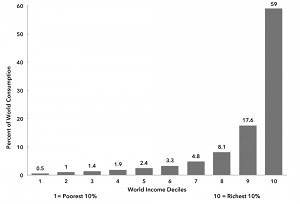

Source: World Bank, 2008 World Development Index, 4, http://data.worldbank.org.

It is a bit little hard to see the numbers in the graph above, but what it is really about is the great discrepancy that currently exists between rich and poor. Specifically, it shows us is that the poorest decile (10%) only consumes half a percent of the total and poorest 20% only consume 1.5%, a small fraction of an even share, which would be 10%. While the richest decile of humans account for 59% of consumption and the richest 20% account for a whopping 76.6%. This means that the richest 10% out-consume the poorest by a factor of almost 120! So it’s pretty clear that the poor are not to blame for our overall overconsumption, and controlling their population isn’t the real issue. The real issue is bizarre levels of overconsumption by the rich.

It is interesting to engage in a moment of daydreaming about what the effect of reducing that overconsumption might be. If that richest 20% of our population was to reduce its consumption down to an even share (20%), our overall consumption would be reduced to less than half of its present level. And in the process no one would be denied the necessities of life, in fact those in the top 20 percent would still consume more than the rest of the population, just not by so wide a margin.

I am not suggesting that this is exactly what we should do, and it would by no means completely solve our problems, but it would give us breathing room to begin seriously doing something about them. Like getting our population under control by educating women and making family planning alternatives available to them. Like reducing the burden on the areas of the environment we have not yet seriously damaged, and allowing those areas that are seriously damaged a chance to recover.

Of course I do realize that the richest 20% are also overwhelmingly the people who run the world. For the most part they run it for their own short term benefit, so nothing of this sort is likely to happen any time soon.

This where the word “disingenuous” comes into the discussion. If you listen carefully to discussions of sustainability by the overconsuming rich (and most people in the US and Canada fall into that category) you will hear a lot of deception disguised as naivete. Sadly it is to be found on both sides of the argument. Let me explain what I mean.

On one side of the discussion are the “Business as Usual” people, who have a great deal invested in the way the world currently works, and want to see it continue that way. Here is a link to a pretty good statement of their viewpoint: only growth can sustain us. I am pretty sure that these people realize that we live on a finite planet and that there are some pretty clear limits which are already bringing an end to unbridled growth. But they simply cannot conceive of any alternative to an economy based on growth. How they reconcile the conflict is quite simple: as long as more and more people consume less, a few can continue to consume more. The people at the top of the heap earned their position there and they deserve their privileges. (NOT!) This may even represent a real solution to our sustainability problem, albeit a repugnant and immoral one from my viewpoint.

The majority of people in political positions of power hold this viewpoint and they know they can stay in power by convincing the public that everything is OK and that with just a little tweaking the system can be switched back into growth mode again and everything will return to normal. And of course they are the ones with the expertise to do that tweaking. One even hears these people spouting bogus ideas like “sustainable growth” and “being rich enough to afford to fix the environment”.

This sort of playing dumb to sell a position beneficial to your own interests is what I would call really disingenuous. It is compounded when powerful organizations (usually corporations with a vested interest) spend money to set up fake think tanks or supposedly “academic” institutes which then proceed to produce misinformation/pseudoscience about peak oil, global warming and so forth.

On the other side of the discussion are the people we might as well call the “greens” (small “g”). They are quite aware of the sustainability challenges we face. They also believe (as I do) that the place to start reducing our burden on the environment would not be among the poor, but among the rich who consume so much that their lives are actually burdened by that consumption. But they are equally aware that being less rich is a pretty tough idea to sell. So they have a conflict to resolve as well. It is a serious one because, for the purposes of this discussion, the great majority of people in a places like the US and Canada qualify as rich.

The greens resolve this issue this with the “soft sell”, trying to make sustainability a “cool idea” and fun to take part in. Perhaps the clearest example of this is the Transition Town movement. Their leaders are clearly aware of the seriousness of the challenge we face and the degree of change in our lifestyles that is going to be necessary. But they speak of a process which is “more like a party than a protest march”. In fairness, I believe that is a reference to the camaraderie experienced by those by those working together in this cause, but I have also observed that many of people who are attracted to the Transition movement are not fully aware of the situation, and would not be so enthusiastic if they knew where the movement was really leading them.

And, not just to pick on Transition alone, there are many other groups selling ideas like saving polar bears, investing in renewable energy or buying “carbon credits” as the answer to the problem – answers that won’t require any significant change in our lifestyle.

I guess by this point it should be clear that, once again, I see this sort of thing as really disingenuous. It is vital, in my opinion, that we come to grips with the reality of the problem facing us and having done so, get to work fixing it. There is a solution, it’s just that the people who are causing the problem (and have the power to solve it) have all agreed not to discuss it. Until this changes, things will only get worse.

Here are some links to further discussions of sustainability:

Tuesday, 26 February 2013

What I Believe

In an earlier post I defined belief as "a last resort to turn to when the currently known facts and the best available explanations of them don't answer your questions and you must have an answer on which to base your decisions. Beliefs should be avoided at all costs, much better to admit that we don't yet know and just continue searching. But the world being what it is, there are many decisions that must be guided, at least in part, by nothing more substantial than belief."

So you might expect that I don't believe much. But as I said, the world being what it is, there are many decisions to be made and we don't always know enough to base those decisions on knowledge. So one has no choice but to formulate a belief, based on little more than a gut feeling -- intuition if you will. There is actually quite a bit to be said for intuition in the many cases where there is not a better way of knowing.

It's time that I 'fessed up and shared some of those beliefs with you. The first half of this post was available on this blog, not as a post but as the separate page "What do I believe" for some time before being posted here. But I've added quite a lot of new material in the second half.

To put a name to it, I am a monistic materialist (or materialistic monist, same thing). This means I believe there is only one thing, and that is the material universe that we see around us and that we are part of. That's where the materialistic part comes from. It does not, by the way, mean that I am a materialist in the sense of "he who dies with the most toys, wins." Far from it. But more on that later.

The "monistic" part is important too -- there really is only that one thing and everything is part of it. The many "dualisms" that people believe in are serious errors in thought, with big and nasty consequences. Here are a few of them:

1) That there is a god separate from and outside of the material universe, who is its creator. This unnecessarily complicates one's thinking. If the universe had to be created by someone, then so did god, and whoever created god and so on in an infinite regress that gets harder and harder to believe. Stop at just one hard thing to believe: that the universe simply is. Furthermore the idea that the world was "designed", that the way things are is "meant to be", is a fallacy. The way things are is a combination of natural law and chance. When applied to life, we call this evolution. But something very similar has been going with the inanimate part of the universe as well. And it is very important not to start making value judgements about how things are. Because there is no creator and no "intention", one way is not inherently superior over another.

2) That mankind is a special part of nature, created to have dominion over it. This is the source of much of our current abuse of the environment. I would say we are a part of nature, with no special status or role, and actually totally dependent on nature -- it feeds, waters and clothes us and provides for us to continue breathing. When I was younger I thought that we would someday have the technology to overcome this dependence, but now it's looking pretty unlikely.

3) That there is a material universe and a separate mystical or supernatural one. Nope, there is only one universe – the material one. Our brains, however, can generate many experiences internally which seem "real" in some sense, but are not in fact experiences of any sort of external world. Having an active internal life is a necessary consequence of being able to think, but a great many people have made the mistake of thinking that their internal experiences are putting them in touch with another, perhaps higher, level of reality. Such experiences can be brought on in their most powerful form by using psychoactive chemicals of various sorts and can leave the most skeptical user convinced that they are real in a very concrete sense. Prayer, meditation, fasting, oxygen deprivation and rhythmic activities like chanting, drumming and dancing can also be used to cultivate mystical experiences. The important thing to realize is that the only thing you are getting in contact with through these practices is the inside of your own head. That in itself can be useful, but only if kept in the right perspective.

4) That our soul is a separate thing from our bodies with an independent existence that is eternal. Rather, I would say our consciousness is essentially a computing process running on the biological computer between our ears. As long as that "meatware" is running, our consciousness (or spirit or soul) exists as an emergent property of that process. It is not separate from our brain and can perceive and act on the material world only through our bodies. When the meatware stops running, the soul ceases to exist.

After hearing all of the above, it will surprise many conventionally religious people that an "atheist" like me is big on spirituality. Though what I mean by spirituality, since it doesn't include the supernatural, may be a little different from what you'd expect. Over the last few hundred years, science has displaced religion in providing our understanding of how more and more things work. For those who accept science, the realm of spirituality has shrunk and shrunk to almost nothing. Even our consciousness is understood as just a property of the computing processes going on in our brain. All that is left to the religious is some sort of supernatural essence whose existence is not even falsifiable – I would say it is simply imaginary. But I would also say that it is time to expand our understanding of the soul back to include what it properly should. Here I'll borrow an idea from Plato, via John Michael Greer (who gave it some modern twists) and add a few more of my own. Liken the soul to a chariot, which has three active parts. The driver is your mind or intellect, which is in charge of two unruly horses. One is your body with all it physical sensations and appetites -- pain, thirst, hunger, the sex drive and so forth. The other is the world outside your skin, which you are part of and which influences you in many ways. Since we are a species which naturally lives in groups this very much includes the obligations, influences and pressures from the people around us, but it also includes the rest of nature. If it sounds like I am saying that our souls are made up of our minds, our bodies and the surrounding universe, that is exactly right. We are part of nature and it is part of us. Everything is connected together, and I do not mean in some mystical, supernatural sense, but in straightforward chains of physical cause and effect.

We must learn to use the mind to control and balance both internal desires and external pressures -- not just to rein them in, but also to give them their heads when appropriate. All without letting the intellect itself get out of control. This endeavour is what spirituality is all about.

But our souls don't come with either an operating or a maintenance manual, so this is quite a challenge. Especially since so much of the supposed wisdom on this subject is complete bunk. How can it be that so much of the world's sacred knowledge is actually nonsense? That is a question that deserves an answer, and I think I have one.

Remember that for most of mankind's history you came to know things by accepting what older and wiser people told you. Only since classical times (a couple of thousand years) have ideas been required to be internally consistent. Only since the enlightenment (a couple of hundred years) has the practice of checking our ideas against reality been seen as a necessity. And even now there are still a great many people who aren't anywhere near that rigorous in their thinking. Of course, there are some pretty big advantages to accepting traditional knowledge. Much of our success as a species comes from not having to rely solely on inherited instinct, being able benefit from what previous generations have learned and to pass what we have learned on to future generations.

But there are also some disadvantages to this, the foremost being that those older and wiser people are in a position to seriously take advantage of you, especially if you've been brought up to blindly accept rather than question and test what you are being told. Religion has traditionally held a monopoly on spiritual guidance. The leaders of your religion may have the best interests of you and your soul at heart, or maybe that's a secondary concern for a large and complex organization whose chief goal is to maintain and extend its position of power in society, which is based on its having power over you.

If our spiritual guidance is not to come from religion, then where? There certainly no lack of spiritual guidance out there, the trick is to sift the good bits from the chaff. I believe in using my intellect to do this, and this means striving to master and use the best thinking tools available. This starts with logic, critical thinking, the scientific method and skepticism. A skeptical attitude is extremely useful, and constitutes the basis of true spirituality in my opinion.

As with any tool, it is important to be aware of the limitations of these methods. Mechanistic, reductionist science does a fine job of dividing natural phenomena into manageable bits and then describing and predicting their behaviour. But when it comes to understanding how these bits fit together into systems and predicting the behaviour of those systems, our current methods have limitations. It's worth discussing this a bit more, since so much of our Western worldview is based on it.

Take celestial mechanics, which applies the principles of physics to predict the motion of celestial bodies such as stars, planets and moons. 150 years ago this was viewed as one area in which mechanistic science ruled supreme and it did much to advance the idea of a clockwork universe. The idea was that if we know the current state of a system and the physical laws that govern it, we could predict its future behaviour. But we were kidding ourselves. Even now we haven't solved the three body problem in celestial mechanics. That is, predicting the movements of three masses in each others' gravitational fields. For two bodies we have a clean, precise mathematical solution. But for three or more, a true solution has thus far eluded us. Given time and sufficient computing power, we can use "numerical methods" to come up with reasonable accurate approximations in most situations. But as systems grow more complex this becomes more difficult. Some of the moons of Saturn move in "chaotic" orbits. In this sense, chaos refers to the behaviour of a system where small differences in initial conditions yield widely diverging outcomes. This renders long-term prediction impossible in general because you'd have to determine those initial conditions with infinite accuracy in order to know where the system is going. This happens even though these systems are deterministic, meaning that their future behavior is fully determined by their initial conditions, with no random elements involved. In other words, the deterministic nature of these systems does not make them predictable. This happens in some pretty simple systems. Most of the really interesting systems such as weather, organisms and ecologies are interconnected, complex and non-linear which makes them very difficult even to describe, much less predict. This should bring us up short whenever we talk about controlling or “fixing” those kind of systems. Our continued survival on this planet is utterly dependent on the continued functioning of such systems and while they can stand a little bit of tinkering, they don't respond well to the sort of wholesale exploitation that has been going on recently.

So analytical thought, using present day tools, has limitations. Maybe someday we'll develop better tools (it's happened before), or we'll learn to cope better in an uncertain universe – that's where my efforts are focused. I'm not saying that logical thinking is useless, far from it. Or that we should give up on critical thought and wildly accept any sort of bizarre notion. Just that we shouldn't get overly cocky about what we can understand and control. But analytical thought is not the only thing our intellects are good at – creative thought is also important, and without it life is sterile and meaningless. We should occupy ourselves not just with sorting through existing ideas, but also with generating new ideas which can then be sorted. There are tools for this kind of thought as well, and it is worth studying up on them.

Beyond that, there is much more to life than just thinking. The intellect may steer the chariot, but our motivations, the things that get us up in the morning and keeps us carrying on with life, come primarily from our physical desires and the connections we have with the world around us and the other living beings in it. Curiosity and creativity are just about the only intellectual motivations. Other than that, if you think that you are doing something for logical reasons, you're probably kidding yourself. Look a little deeper and you'll find that your real motivation is a physical desire, or more likely, a connection that you feel to another living thing or things, usually but not always, another human being. This isn't necessarily a bad thing, often it is a very good thing, but if you aren't even aware of it, then you certainly won't be able to decide whether it really is a good thing or not. You'll just be along for the ride.

This brings me to the issue of free will. Current research on the workings of the human mind leads us to believe that free will may be an illusion. You decide to move you hand, but in fact the nerve impulse telling your hand to move left your brain a fraction of a second before you experienced making that decision. It appears that your consciousness is building a narrative of what's going on in your head after the fact, that the ability to make a decision is an illusion, or maybe a reflection of something going on at a much deeper level, of which we aren't directly conscious. This places all the traditional thinking on morality on very shaky ground. But regardless of the underlying reality, we do have the experience of being able to make choices and even deciding not to choose is in itself a choice. So best to proceed as if you have free will and choose to do the right thing. But wait a minute, I just chucked out millenia of wisdom on what the right thing might be. What do I use to guide my decisions?

The thing to do is to think about consequences. If you do, or don't do, something, what will the result be? Of course, many people are very good at taking the first step in this direction. If we do such and such, then the result will be what we planned and all will be well. But actions don't usually have just that one intended result, but other unintended results as well, and beyond that the world tends to react to what we have done, and in ways we never expected. Be aware of this, plan for it, but try not to be paralyzed by it, either.

When dealing with other human beings, two principles can be appled: benevolence and universality. Do no harm and when possible, actually help. This applies not just to people in your own "in group" but to all others, as well.

I think that this should probably be extended to the rest of nature. But one must be aware that benevolence may take different forms when applied to nature than to humans. Specifically, I am thinking here of the circle of life, and the fact that we as omnivores are part of that circle, naturally causing death so that we can eat and then dying in our own turn and returning to the soil.

Of course, what I believe is a work in progress, and I don't mean to tell other people how to live. In fact, I don't believe that I should. So it is almost time to stop, but just to stir things up a bit, I thought I'd share with you my thoughts on some of the current standard controversial issues. Let me preface this by saying that I don't believe in "inalienable rights", but there definitely are privileges that a society should attempt to guarantee its members if it is to be successful. So I'll use the term "right" below, but that's what I really mean.

GLBT(That's gay, lesbian, bisexual and transgender for those who haven't been following this one too closely.) This is the latest civil rights issue, not that racism has been eliminated or feminism achieved its goals, either. But I'm against racism, in favor of feminism (or more properly humanism), and definitely in favour of GLBT rights. Love is rare enough and I wouldn't outlaw it in any form it might take. The Wiccans have a couple of good sayings about this: 1) “any act of love is an act of worship of the goddess”, and 2) “and it hurt no one, do as you will.” Good advice, though the second part is a lot more restrictive than it might appear at first glance. Unfortunately, the patriarchal religions have used sex and love as a way of controlling people, restricting them to heterosexual marriage sanctioned by the church, on pain of eternal damnation. Talk about using “spiritual guidance” as a way of manipulating people.

Abortion. What this is really about is a choice between murder and slavery. Yes, abortion is clearly the murder of an unborn child. But forcing a woman to carry that child if she does not wish to do so is clearly slavery. As is so often the case, we must choose the lesser of two evils. For me, the lesser evil is to murder an unborn child who exists mainly in potential. Enslaving women is a much more serious evil. Unfortunately, it is one that we (even women) have become accustomed to.

Capital punishment. Seems to me taking irreversible action on limited information is a bad idea. The real world is a messy place and very rarely do we know all the circumstances surrounding a crime. I'd always rather let one guilty man go free rather than execute one innocent man. And why not address the root causes for crime for a change?

Gun control. Technology is designed by people, deliberately, with an aim in mind. It is NOT neutral. In the case of guns, that aim is to kill. This is not an unintended consequence — it is the very heart of their being. It is fairly hard to imagine what else one might do with a gun (use it as a club, perhaps?), and most shots fired during history have been fired at other people. We use a lot of euphemisms in connection with guns. We say “put” down suffering animals, or “control” pests, but we mean kill them. We talk about “hunting”, but we mean killing wildlife, perhaps for food that we need to live, but more likely for sport, trophies and some very high priced luxury meat. We say we need a gun for safety, but what we mean is to kill anyone who we perceive to be threatening us. It’s all killing, all death. Some of these deaths can be justified, others not so much… But gun control is a done deal in most countries except the US, where guns are readily available and the public is very much inclined to use them. Seems to be a feeling there that violence is the solution to your problems (though obviously, not everyone in the United States fits that stereotype). To someone from Canada, this is a bizarre situation without an immediately obvious solution. But making it harder to get guns has got to do some good.

War. War between states is all about building and maintaining empires. Or opposing empires, if you are on the other side. While war doesn't benefit people, it certainly can benefit the states who use to maintain and expand their empires. Accordingly they do their best to convince us that there are good reasons for going to war. Don't be fooled.

All this talk about controversial issues reminds me of what I call The "Not Two" Thing. This is related, I suppose, to those erroneous dualisms I mentioned back at the start of this post – sort of. Basically, whenever you hear someone presenting an issue as consisting of two opposing sides, alarm bells should go off in your head. Pick one side or the other and you have already been manipulated in taking sides and accepting a simplified version of things. The odds are that someone benefits from this, but probably not you. This binary thinking is a form of laziness and whenever you find yourself falling into the old binary groove, try a little harder to see that in one sense there are many sides to the issue, many possible solutions. And in another sense, there is only one thing – one universe, one planet we're living on, one human race and that the supposed opposing sides may actually have common interests. Many or one, but not two.

I said earlier that our soul comes without either an operating or a maintenance manual. So far we've been talking about operations, but maintenance is also important. Occasionally it is important to give the intellect a rest, exercise the body and enjoy some contact with nature. So go take a walk in the bush, it will be good for you. Or a walk in the park, if that is the best you can do.

Thursday, 13 December 2012

Emergency Preparation, Part 2 – what I am doing – Bugging In

In my last post I talked in a fairly abstract way about emergency preparation, and promised that next time I'd get more specific. It has been a long time since that post. The last few months have been the busiest season for my printing and sign business and in the garden, so there just haven't been enough hours in the day. But beyond that, this is a huge subject and, I have found, quite hard to compress into a reasonable amount of space.

But it's past time that I made a start, and I'll do that now by talking about the threats that I am most concerned about and the preparations I've done and plan to do. I'll limit this discussion to the short term issues and to threats that I am actually facing personally. I live in a small town on the eastern shore of Lake Huron and I work at home, so my situation may well be different than yours. I don't pretend to be an expert, but I hope my thoughts on the subject may be of some help to you.

Despite long term plans to the contrary, I still own and drive a car. This is a pretty dangerous activity and liable to lead one into emergencies. Back in the summer I was involved in a collision and it brought home a few things that I hadn't been taking quite seriously enough. There isn't much use in having a cell phone for emergency use when driving if you leave it at home on the kitchen counter. And it's not much good having a nicely typed up list of one's medications and surgeries if, when you get to the hospital, you remember that you have neglected to print the list out and carry it with you.

The good news is that I survived with no more than bruises and scrapes. But it does make clear that thinking and studying about emergency preparation is not too effective if you don't actually follow through and do something about it.

Money. Practically speaking, this is very useful stuff. In the short run, having some can solve a lot of problems, even in emergencies, and there is no doubt that to be cut off from access to one's money can constitute an emergency. During my lifetime, access to the money one has in the bank (and credit from the bank) has become much easier, largely due to debit and credit cards and the ready availability of electronic transactions. Now one can live for weeks at a time without ever touching cash. But the financial system and the electronic communications systems that it relies on are a prime example of complex infrastructure that can fail.

In 2008 the world's financial system experienced extreme stress. Some banks actually failed, others tottered on the brink. Despite all the attempts since then to patch the financial systems back together, it is still in pretty rough shape. Current economic and financial troubles in Europe are enough to make anyone nervous. It seems more and more likely that they will not be successfully resolved and that a crash far worse than 2008 awaits us. If the bank you rely on fails, in the short run you aren't going to be able to access the money you have on deposit. In the long run, deposit insurance may come through and save at least some of it, but what are you going to do in the meantime?

A sufficiently large solar flare, the detonation of a nuclear weapon in the upper atmosphere, or perhaps even a clever hacker could knock out communications over large areas of the planet, wreaking havoc in the financial system. Even localized power or communications failures can stop your credit and debit cards from working.

So, cut off from savings and credit, how long will it be before you find yourself in desperate straits? Out of groceries, gasoline, other necessities of life? So I like to keep some cash on hand. For obvious reasons I'm not saying how much or where it is stashed, but it is readily available in an emergency. So far, it's only been used to buy milk during a power outage, but it is there if we need it, and at today's interest rates it wouldn't be earning much in my savings account anyway. Reserve cash is useful if one looses one's job or the monthly pension payment doesn't come through. If you are already living on a tight budget it can be hard to accumulate much cash, but you are even more likely to need it and a cash reserve (even a small one) can make a big difference when you are in a tight spot.

Bugging in. In survivalist terms, I'm planning on "bugging in" rather than "bugging out". That is, I intend to weather out most emergencies that may come along right here where I am, rather than seeking refuge elsewhere. So I'm concerned about the supply of utilities to my house and the flow of vital goods to this moderately remote town. And it seems that energy, once again, is the crucial resource – in this case electricity and transportation fuel.

Energy. Strangely, natural gas isn't available in this area, so when we built this house in 1982, we chose electric heat. I worked for the provincial electric utility and felt better about paying my own wages than someone else's, so to speak. Our house is very well insulated, the cost of power here in Ontario has stayed relatively low, and outages longer than a few hours have been very rare, so this hasn't seemed like too bad a decision. So far. But it does look like we can expect more trouble ahead, what with global warming/weirding bringing more and nastier storms our way and reduced maintenance budgets leading to more frequent equipment failures in the local grid and slower response to those failures.

To a certain extent we are well prepared for power failures. We have flashlights, candles, a Coleman lantern, a Coleman stove and catalytic tent heater and a couple of gallons of Coleman fuel on hand. We also have a carbon monoxide detector and we open a couple of windows when we use any of the Coleman appliances indoors. It's not recommended, I know, but so far there have been no problems and no hint of any carbon monoxide accumulating. I also make a point of going outdoors to refuel the Coleman appliances – we have the liquid fueled variety and that stuff is deadly flammable.

But if a power outage lasts longer than 24 hours we are actually quite vulnerable in several areas. In the winter, heating becomes a problem. In summer, and to some extent even in the winter, the food stored in our freezers is definitely at risk.

A wood stove was in the original plans for our home, but what with one thing and another, it has never happened. Currently the place where it was supposed to go is being used to store paper for the printing business, which is hardly compatible with a wood burning stove. When we wrap up the business in a few years, the stove will be among the first additions. In the meantime rather than just saving for this addition, we may actually buy a stove and chimney parts as the money becomes available and set them safely aside until they can be installed. I have a suspicion that at some point wood stoves are going to get very popular in this area and hard to find, as well.

It is probably well within my skills as an electrician to set up some solar panels and a battery bank and inverter that would supply enough power to keep food frozen in our freezers. Though from my fairly extensive experience with battery banks, I have to say I'm am not too thrilled with the prospect. They are expensive and have a distressing short lifetime. A generator is tempting, but also expensive and requires a lot of maintenance if it is to be relied on. And of course, gasoline may no be readily available during an emergency.

But there are some other less obvious impacts of a long term power outage. Beyond electrical power, the other two main utilities we rely on are water and sewers. Both are dependent on electrical power to function.

I think for most people a failure of the sewer system is pretty much unthinkable. Yet every time there is a power outage longer than an hour or so, the town sends a vacuum truck to a location about a block from us and starts sucking something out of an access port. Sewage does not flow uphill by itself and evidently it wouldn't take long for it to start backing up. I hope they keep the fuel tanks on that truck topped up and that some thought has been given to refueling it when the power is off. That is a surprising weak point in many emergency plans.

We have a bucket, a bale of peat moss, a spare toilet seat and a sheet of plywood waiting to be turned into a composting toilet, (a la Jenkins). But I really should find the time to do it when I can use a power saw, rather than cutting that plywood up by hand. Plans are available here. Note that the length of the legs may have to vary according to the height of buckets you are using. In the same vein, we keep a generous store of toilet paper on hand. There are alternatives, but no one I know personally wants to discuss them.

Water treatment and distribution is vulnerable of several fronts. Electrical power is needed to operate the treatment plant and pump water around. Supplies for the treatment plant arrive here via diesel truck on the highways, with only supply for a week or two in stock at any time. And already we have had one occasion when the lake got so rough that the particulate matter in the water overwhelmed the treatment plant and we were advised not to drink the town water without boiling it. The municipality provided bottled water free of charge, that time.

So having some water on hand and facilities to filter lake water sounds like a good idea. We have a 60 gallon water heater and I flush it once a year or so. If we loose town water pressure, we've got 60 gallons to work with. Of course, if town water becomes contaminated, the water in the heater tank will be contaminated too. So we store a couple of 5 gallon plastic carboys full of water in our basement. I also have on hand filters and parts to build a water filter similar to the Berkey or Doulton/Berkefeld ones, using a couple of food safe 5 gallon buckets, which I also have on hand. Another case where I need find a little time to put the filter together before we find ourselves in need of it.

Water can also be treated using bleach. We make a point of keeping a jug of bleach on hand. Instructions here

Food, etc. This brings me to the question of how things get to our little town. The answer is almost entirely by highway, in diesel fueled trucks. And pretty much everything is delivered on a "just-in-time" basis, with only a very few days stock kept on hand locally. Apparently this reduces inventory cost for the businesses involved, constituting a more efficient use of their money. But as always, an increase in efficiency mean a decrease in redundancy and the ability to respond to emergencies. If trucks can't reach our town for even a few days, we're in big trouble.

Here's a link to a discussion of this in more detail, including a report produced by the American Trucking Association as a warning to government officials about how bad an idea it would be to shut down truck traffic in emergencies like rioting, epidemics and so forth. In this area, I am more worried winter storms, fuel shortages or rationing and the inability of the whole system to cope with high fuel prices. Storms regularly close the highways hereabout for a few days at a time. So far the plows have always made it through (and the trucks behind them) just in time to restock the shelves of the grocery stores. But what if there is no fuel for the snowplows?

It wouldn't take much to change our current "next day delivery of anything you can dream of" to irregular delivery of the bare necessities. Trucking is currently done on a for-profit basis and as fuel prices have gone up the trucking business has become less and less profitable. This is already pushing shipping prices up, stressing a system that doesn't have a lot of slack built into it. At some point this may lead to disruptions in service like trucking strikes or enough trucking companies going out of business so that the system no longer works smoothly.

Medical supplies, food, cash and fuel are the most immediate concerns. My response is twofold: first to store enough of what we need to see us through short term emergencies and second to find and encourage local suppliers.

So, we try to keep our prescriptions filled before they run out, we have a few weeks supply of food and other household necessities in the house, we keep the car at least half full of fuel and, as mentioned earlier, we keep some cash on hand.

Food storage is an important enough concept that it deserves a little more attention. I am definitely not suggesting you order a year's supply of freeze dried emergency rations that you can leave stashed in a safe place for when they may (but hopefully won't) be needed. Aside from spending a lot on something that you hope not to use, this is a bad idea on many other levels, especially when there is a viable alternative that is a good idea on many levels. I come from a farming background – it was only a couple of generations ago that my ancestors grew most of what they ate. Each summer they grew enough to last until the next summer. Much has changed since then and now it is almost frowned upon to have more than a few days of food in the house. This strikes me as nonsense – there are all kinds of benefits to having at least a few weeks of food on hand. I am talking about "stocking what you eat and eating what you stock".

There are many benefits to this sort of food storage. Buying in bulk costs less, you can take advantage of sales and better prices on whatever is in season. Having ingredients on hand to make almost anything you might want at a moments notice is pretty convenient. It can also be thought of as an investment against rising food prices. If you buy food now that you'll need in a few months when the prices are a few percent higher, you have saved the difference, with a rate of return that is often higher than the banks are paying. A well stocked pantry provides some security against job loss or unexpected expenses. And of course it provides security in the case of emergencies which interfere with the food supply.

We started at this by keeping one extra of everything we use regularly and restocking when the last container is opened. This means we never run out of anything when the stores are closed. Then we added more when things were on sale.

This sort of food storage leads naturally to growing some of your own food and sourcing much of the rest locally and when it is in season. We are in the middle of a major agricultural area, so it seem that finding local sources of food would not be too difficult. But most of the food grown here is shipped out of the area for processing before it ends up back in our grocery stores, so this isn't as simple as it might seem. Part of the battle here is learning how to cook from "scratch", using basic ingredients as they come from the garden or farm, and having the equipment needed to process and preserve some of these ingredients yourself. More details on this in future posts.

In addition to all of this, there are some threats to the structure of our home that do concern me. Floods aren't a big worry in our present situation – we are close to the lake and there is enough slope so that water flows past us rather than accumulating. Nor are earthquakes a major concern, but tornadoes and fires are unfortunately a realistic possibility. But this leads us to the idea of actually having to "bug out" -- in some situations you can't cope by staying at home and fending for yourself, mainly because your home itself is threatened. There may be no alternative but to leave.

That, however is a subject for another post, and one that will be some ways down the road, since I am still struggling with everything that is involved in bugging out. For now, there are a few more things I'd like to say about bugging in.

Emergency response organizatiosn in both Canada and the U.S. advise us to have a battery operated radio to keep up with the progress of events during an emergency. We have one that includes a hand cranked generator as well as batteries and has a flashlight built in. AM, FM and a couple of short wave bands. I am not really too impressed with its performance, but it will bring in the local stations, and work when there is no other source of power, which is what we need.

It should be obvious by now that I am mainly concerned about fairly short term emergencies which leave our response infrastructure intact, though perhaps swamped. We are going to see more and more of these as climate change worsens and I think each time, we'll only manage to put things part way back together, leading to a continuous slow decline. But for now the official word is that you should be prepared to be on your own, without help from the authorities, for as much as 72 hours (3 days). Looking at the aftermath of hurricanes Katrina and Sandy, that seems ridiculously optimistic. I would say prepare for two weeks are the very least.

Let's suppose for a moment that you've just lived through a disaster, you didn't panic (too much), you found your preparations to be reasonably adequate, and now you are checking around to see what help you can be to your neighbours and your community. There is a large body of mythology, perpetuated by the mass media, about how people act during disasters. Based on that, you may be concerned about looting and other chaotic, selfish and violent anti-social behaviours, but studies of actual disasters show that the opposite is usually true – ordinary people work together with a great deal of resourcefulness and altruism to respond to the challenges they encounter.

You may have noticed that I don't seem too worried about the ravening zombie hordes that seemed to be a major preoccupation of survivalists. They do make great plot devices for apocalyptic stories, but have little basis in reality. Unless, of course, you live in an area (probably a large city) where society is already largely broken down. If that is the case, a move might be something to think about before it is too late.

Of course the effectiveness of your own response will depend on the skills you have and tools and materials you have on hand. It always shocks me to realize, after having spent most of my life around farmers, construction workers and maintenance people, that most people don't even have so much as a multi-tool in their pocket, and wouldn't know what to do with one if they did. I suppose this is rather harsh, but the good news is that good tools and information on how to use them are readily available today.

There are a great many emergencies that can easily be coped with if you have the tools and materials needed. Some of these things are so useful that you should consider carrying them with you pretty much all the time. Others you should have ready in your car and home. I would encourage everyone to become more familiar with tools and the things that can be done with them. Learning to use you hands can be very rewarding in normal circumstances and can make a huge difference when the chips are down.

Everyday carry. On my keychain is a tiny red LED flashlight, powered by a coin sized lithium cell. Very useful, although it does have a tendency to get turned on accidentally while being carried around and before long the battery is dead. In my pants pockets I carry two folding, lockback knives: a 3.75" Gerber Gator and a smaller knife with a 2" blade. The larger of these is affectionaltly known as my pocket machete – it is big enough for heavy work. The smaller is kept very sharp and used for more delicate jobs. Also in my pants pocket are kleenexes (I suffer from allergies) and a pack of dental floss. the latter is great if you have something stuck between your teeth, but also useful if you need some string.

In my jacket pocket is a multitool, a small flashlight, a loud whistle and a waterproof container of matches. My multitool is a Gerber and if I had it to do over again, I'd get a Leatherman Wave with the set of screwdriver bits that is available for it. I've looked around for for small multi-bit screwdrivers, but never found a set that was light enough to carry in a pocket.

I have small knapsack which is full of useful items that I carry on hikes and take with me on car trips out of town. This is not the classic bugout bag, in that it is pretty light on water, food and shelter. But it does contain a compass, signal mirror, fire starting supplies, rope, string, first aid supplies, a screwdriver with a selection of bits, a plastic poncho and a plastic emergency blanket, a pad of paper and some pencils and pens. Just things I don't like to be without, that help in coping with the various situations one find oneself in.

In the back of our car there is an ice scraper/snow brush, a shovel, an axe, and a box containing booster cables, windshield washer fluid, emergency candles, a couple of blankets, several cloth wipers, and some rope. And before we set out on a trip of any length we make sure to have a generous supply of water with us.

As for the tools and materials you might want to keep around the house, well, the scope is so wide that I hardly know where to start. Basic mechanical, carpentry, plumbing, electrical and gardening tools, for sure. Spare parts for things that wear out regularly. Nails, screws, glue, caulking, tape, lumber and plywood, copper and plastic pipe, plastic sheeting, tarps and so on. It all depends on your skills and ambition.

These certainly aren't authoritative lists of what you need, but I hope it will give you some ideas. You will have noted that a gun does not appear anywhere on these lists. In fact I do not own a gun and don't see the need for one. Of course, this is Canada. Maybe things really are different in the States, but even there I have to question the national obsession with firearms.

On that note, I think it is about time to wrap up this post. Below a some links to resources that I can highly recommend.


The is the second post in a two part series:

Saturday, 2 June 2012

Emergency Preparation – what to do first, Part 1

In my last post I talked about how the only question that really matters is "what the heck do we do next?" Then I went on to talk about long term plans for coping with what's likely to happen over the years ahead, promising to address short term plans – "emergency perparedness" – in my next post.

So here we are. It is a plain fact that shit happens, even in completely normal "business as usual" circumstances. With climate change, resource depletion, and economic contraction coming into play, we can expect some types of disaster to happen even more frequently. Some people live a life pretty well isolated from nature, the inner workings of our infrastructure and the grittier side of society and seem to feel that planning for emergencies is like inviting them to happen. Nothing could be more foolish. My own gut feeling (and I know it doesn't really make any sense) is that if I am really well prepared, then there will likely never be an emergency to test out my preps.

It's probably best to begin with the three rules contributed by "FreeGoddess" in her comment to my post What does this all mean?:

  • The first rule is "don't panic".
  • The second rule is "be prepared for anything".
  • Third rule is "help others to do the same".

OK, so we're not supposed to panic. For the first part of my career with the electric utility here in Ontario, I was a journeyman electrician, doing maintenance work in power stations. We were called on to respond to many emergencies, but there was always a supervisor telling me what to do, so it was no big deal. Then I became a supervisor and it was my responsibility to tell my crew what to do. This, especially when the phone call came in the middle of the night, I found to be pretty unnerving. But I learned to stop, take a deep breath, collect my thoughts and try to remember what the plan was supposed to be. There was always supposed to be a plan and people to call for backup, even if we were the first responders.

It really does help to have a plan, to know who to call, to know what to do until help arrives and to have set aside whatever tools and supplies you may need in the meantime. That's were "be prepared for anything" comes in. Of course, there are things you just can't be prepared for, and other things that are so improbable that it's not worth the effort. But when you have eliminated the insurmountable and the improbable, you are left with a list that needs to be addressed. In order to come up with this list, you need to think about the place where you live and the kind of crises – natural, mechanical, personal or social – that can reasonably be expected to happen and that you need to be able to cope with. Notice that I am not differentiating between "ordinary, everyday" emergencies and "end of the world as we know it" disasters. In my view, they exist on a continuum and the mindset that helps us prepare for and cope with them is essentially the same.

I don't claim to be an expert on emergency preparations – you certainly shouldn't stake your life on my opinions. But I hope this will encourage you to do some research of your own and at least begin to take some steps in the right direction. Having said that, here are some of the ideas I have come up with after a few years of study.

Vinay Gupta, an ingenious fellow who blogs here: TheBucky-Ghandi Design Institution, talks about 6 ways to die:

  • too hot
  • too cold
  • thirst
  • hunger
  • illness
  • injury

We are protected from these hazards by essential services – both physical and social – that are provided to us by various sorts of infrastructure. If infrastructure is working right, most of us are unaware of it. But it's not magic and it is subject to failure even in the best of circumstances – I made a living for 30 plus years trying to prevent such failures and coping with them when they happened.

Gupta divides these services into three categories:

  • Shelter protects us from heat and cold. The structure in which you live insulates you from the extremes of outdoor temperatures. Air conditioning and heating system provide further protection.
  • Supply protects us from thirst and hunger.
  • Safety protects us from illness and injury. Public heath, medical system, police.

Threats to infrastructure come in several forms: natural, mechanical, social.

  • Natural threats include hurricanes, tornadoes, blizzards, wind storms, ice storms, volcanic eruptions, earthquakes, tsunamis, droughts, floods, forest fires, solar flares, heat waves and such. But it seems to me that this is a really distorted way of looking at such things. It assumes that this planet was created as substrate for human activities, ours to use (and use up), and that when anything "out of the ordinary" happens that interferes with our activities then things are not as they were "intended" to be. If you've read the "What do I believe" section of this blog, you know that I don't buy into this idea. I don't believe this planet (or universe for that matter) was created at all, or that there is any sort of intention behind the way things work. The human race is certainly not a privileged part of this "creation", nor do we have a special role to play in it, other than whatever role we make up for ourselves. We are as much an ordinary part of nature as any other animal species. But we have spread over almost the whole planet and we have set up our civilization to rely on a certain set of ideal conditions. When real conditions vary from that ideal, we consider it to be a disaster. But really, all of these things are natural parts of the way things work on this planet. We have put ourselves in harm's way, and we shouldn't be too surprised that the results are occasionally disastrous. Many of us live in a way that is very isolated from nature, but that isolation is an illusion. So be realistic about the range of natural events that occur in the area where you live and the ways they may disrupt your life, and be prepared rather than surprised when natural "disasters" happen.
  • By mechanical threats I mean the breakdown of the infrastructure equipment itself. If anyone can clue me in as to a better term for this, please do. Anything that is made by man eventually breaks down. But again, this is a distorted way of looking at things. Rather, I would say that it takes a lot of ongoing effort to keep it working. If left alone technology gradually, or sometimes catastrophically, wears out and breaks down. And the more complex a mechanism is, the more susceptible it is to breakdown. When our economy was growing, the ongoing cost of preventative maintenance, repairs and replacement was something that could be borne without too much pain. But now that growth is ending, those costs are starting to get quite painful. The tendency is to defer them, since for the moment everything is working just fine. After all, most of us are isolated from the inner workings of the infrastructure that supports us, and we'd just as soon pretend it wasn't there. We have just lived through a period when enough was being spent on maintenance that failures were rare and seen as decidedly out of the ordinary. But even during that period it was wise to be prepared for occasional interruptions of vital services, and it can only become more so in the future. So be realistic about the extent to which you do rely on such services and be prepared to get by without them until emergency crews can make repairs.
  • Social threats result from the breakdown of the "social contract", what Vinay Gupta calls "state failure". Many people seem to be unaware that the social contract exists, or if they are aware, believe that it unfairly restricts their freedom. But I've always thought it was a good thing. Basically it refers to the agreement by which governments provide security and infrastructure and guarantee certain freedoms and privileges to their citizens and in return those citizens agree to pay taxes and obey the law of the land. This deal can break down from either side. Governments may welch on their promise to provide security and infrastructure. They may also restrict those freedoms and privileges which they are supposed to protect. Citizens may evade taxes and break the law. And when one side of the social contract starts to fail, it tends to put stress on the other side as well, leading to a downward spiral. The failure of security and infrastructure are our immediate concern, in an "emergency preparedness" sense. But the loss of freedoms and privileges (what some call "rights") may be an even bigger concern in the long run. In any case, it looks like in the times to come, we should be prepared for more social problems – increased criminal activity(random or organized), strikes, riots, revolutions, and wars.

So, I would strongly encourage everyone to look at their own situations in the light of these generalizations, decide services are the most vital and which threats are most pressing and start preparing for them.

This post is getting pretty long and it has taken a long time to write, so I think I'll break it off here. Next time I'll talk about the threats I'm most concerned about and the preparations I have made or plan to make.

But before I go, I'll just draw your attention briefly back to the third rule that I mentioned near the top of this post is "help others to do the same". This is really important in that it sets the kind of preparation I am into apart from the survivalist "hiding in the hills" approach. That seems to be based on the belief that disasters bring out the worst in people and the other people are likely to be one of your biggest problems in an emergency. This is part of the "disaster myth", about which I will have a lot more to say in a future post. It is hard to convince people of it, but in fact disasters bring out the best in people, and rather than behaving as helpless victims, when disaster relief finally arrives people are usually found to have already taken the initiative and started helping each other out.

The is the first post in a two part series:

Sunday, 22 April 2012

What the heck do we do next?

When my kids where younger and occasionally found themselves in what their mother referred to as a "pickle situation", I would remind them that the only question that really matters is "what the heck do we do next?" No use agonizing over how we got to this point, no use obsessing over how bad we feel about it. Time to admit that we really do want to carry on and find a way to do so.

If you've been reading this blog for a while, it should be pretty clear that I think the whole world is in a considerably worse spot than a "pickle situation". Economically, we are facing a general downward trend until our energy use balances out with the renewable energy supply, and there will be lots of crises, emergencies and disasters along the way. There are many ways to approach the subject of preparing for this, but I think it's best to start close to home and at the personal and family level. In an emergency, the rule is to first protect yourself, then help those around you. So I would recommend getting prepared right away for the kind of emergencies that are likely to happen in the area where you live and work. It's no good having a long term plan if you freeze to death in the first blizzard.

Here I'll borrow the three rules contributed by "FreeGoddess" in her comment to my last post: The first rule is 'don't panic'. The second rule is 'be prepared for anything'. Third rule is 'help others to do the same'. Each of these rules brings up a post worth of thoughts that I'll be sharing with you soon. But definitely, you should apply these rules to everything I am recommending below. And one more borrowed rule (from Sharon Astyk) – the "Rule of Anyway", is that your preparations, both short and long term, should still leave you in a good or better situation, even if things don't turn out as bad as we expect. They should be things that you'd want to do anyway.

There is lots of good information on the internet about emergency preparation. Unfortunately much of it is posted by survivalists, who's attitude doesn't sit well with me. The good news, though, is that if approached in the right way, preparation for short term emergencies leads naturally into long term preparations. I'll devote my next post to that subject.

Before I get into what I think our long term preparations should be, there are a few things that I think you shouldn't waste time on.

It is important to understand that the situation we are in is what some people (notably John Michael Greer) refer to as a "predicament rather than a problem". The distinction they are making is that a problem is something you solve, while a predicament has no solution – it is a situation you just have to cope with as best you can.

If you are driving down the road in your car and have a flat tire, you have a problem. It can be solved by changing the tire, and then you can continue on your way, perhaps even driving a little faster to make up for lost time. All that has changed is the tire, and even it looks much like the old one. The idea that you have important places to go and people to see, and that your car is the way to get there, hasn't changed.

If, on the other hand, you commute to your job and the price of gasoline goes up significantly and there are shortages and on some days none of the local service stations even has any gas, then this is a predicament. You may be able to adapt to it, but your life is going to look different afterwards. And bear in mind that if the price of fuel is a problem for you, it's highly unlikely that you can afford a hybrid or electric car. If you are very lucky you may find an affordable older economy car that gets significantly better mileage than what you're driving now, or you may be able to telecommute – do part of you job at home and reduce the number of days you have to drive to work. More likely you will start car pooling, take public transit, bicycle or walk to work. You might move closer to work or take a job closer to home. If you aren't the only wage earner in your family, you may decide that it's actually costing you more to work than it's worth, that you would be better employed at home in the "informal economy".

So, beware of any suggested course of action that promises to "solve" our problems without calling for any changes in the things we are doing that are causing those problems.

I am also unimpressed with the sort of activism where people go out and protest against various environmental problems, and then think they can continue on with a clear conscience, still doing the very things that are causing those same problems. We are all part of and dependent upon our present system, bad as it is, and we shouldn't be too quick to tear down. At least not until we've made a start at building something to replace it. Having just had a run in with some of our local activists, I have more to say on this, which I'll be putting in another post soon.

And lastly, if you've come here for investment advice, I'm going to disappoint you. Wealth is a claim on someone's future productivity. I can't think of any investment that is certain to be able to maintain that claim, even assuming that the future productivity you've laid a claim to is going to live up to your expectations. This includes precious metals. It is a good idea to not to take on any new debt and very likely a good idea to pay it off what debt you have, once you've spent a few vital dollars on short term emergency preps.

Well, maybe just a little bit of investment advice: when the price of food is going up quickly you could buy storable food (that you will need anyway) now, rather than later when it will cost more. There have been periods in the last few years when this would have given pretty much the best return of anything you could invest in at the time. And storing food is a basic part of emergency preparation. But really, we got ourselves into this mess by being altogether too ready to spend money on stuff, so approach the idea of "what do I need to buy to solve this problem" with extreme caution. Skills and knowledge, on the other hand, are investments more of time and effort than money. They are light to carry, and you are more likely to use them than lose them in a disaster.

As we move deeper into the age of scarcity, it looks like we are all going to encounter economic difficulties and in that realization lies the key to effective long term preparation. The game is rigged against us. The thing to do is get out of that game, to whatever extent you can.

Unfortunately, most of us feel a huge pressure to maintain or improve our situation in the "business as usual" world, whatever it takes. For the last few decades that has meant borrowing against our future productivity in ways that seemed likely to enhance that productivity. For those of us not born into wealth, the "game" has gone roughly like this: borrow money to get an education and then get a good job with prospects for advancement. Borrow money to buy a car so you can drive to your job, if you didn't already get one to drive to school. Borrow money to buy a house, more as an investment than a place to live. Plan to pay everything off before you retire, pay into the company pension plan so you'll be able to retire, and make good investments to add to that pension. In the meantime, compensate for a job that you've found you really don't like all that much by buying all the latest toys, taking up expensive hobbies and travelling during your vacations.

There have always been those who pointed out flaws in this plan, even when it was working well – one gets locked into a rut, the job takes you way from your family, and in any case provides a limited degree of fulfillment. But even if you are currently a willing participant in this game, you have probably noticed that it isn't going too well in various ways, depending on your age. University tuition has gone up considerably and jobs prospects for successful graduates are poor. The price of a car and the cost of operating it, especially fuel and insurance, are becoming prohibitive. For those with jobs, job security, benefits and regular raises are all a much more doubtful proposition than they once were. Houses aren't proving to be the investment that they once appeared to be. Retirement recedes into the future as the cost of living goes up and return on investments go down. For those of us who have managed to retire, increasing costs of necessities are making once generous pensions look barely adequate. And pension funds that once looked rock solid now seem pretty shaky, with the possibility of pension cuts looming ahead of us.

The temptation is to continue on as usual at all costs, hoping that things will straighten out soon. Dmitry Orlov refers to the trio of car, job and house as the "iron triangle" – the surest way of locking oneself into the "business as usual" world and going down with it as it falls. Poverty bears an immense stigma in our culture and we are very reluctant to look or act "poor", even if that is the surest way to avoid becoming really poor. But a good piece of advice for a man who finds himself in a hole is to stop digging before you make it even deeper. The age of growth and progress is over and we are entering the age of scarcity. There is no remedy for that and it's time to start adapting to the new situation, rather than denying it exists.

So, the thing is to realistically access your situation in the light of this and admitting that it is likely to get worse, take steps that will allow you to cope. Having done that, you will find yourself living some years ahead of the curve -- living as you would have been forced to do anyway, eventually. But you'll be making the changes at your own pace, while you still have some money left to finance things like emergency preparation, setting up a garden, insulating and sealing your house, installing a woodstove, a solar water heater and so forth. A few years down the road, others will find themselves forced to make the same sort of changes to their lifestyles, but not willingly, almost certainly not happily and with far fewer resources at their disposal. And if things don't go as badly as I am predicting, you'll have your debts paid off, money in the bank, and you'll be accustomed to living frugally, so that whatever your circumstances, you'll feel like you are doing better than most of the people around you because you have more realistic expectations.

All this is sometimes referred to as voluntary simplicity or voluntary poverty. But all of these terms carry certain misleading connotations, so rather than trying to name what I am talking about, I'd like to go on talking about it in enough detail to make it clear what I really mean. Unfortunately, I just spent the last two weeks trying to write up some specifics of how one might actually "get out of the game". But there is material enough to fill a book (or several) and it is not the kind of stuff that will condense into single paragraph chunks without losing a great deal. So I think that instead of continuing now, I'll do a series of posts about various aspects of this subject, giving each enough attention to do it justice.

Before doing that, though, I'll be devoting my next post (as promised above) to emergency preparations.

Friday, 30 March 2012

What does all this mean?

If you've read all of my posts so far, you may be wondering where I am going with all this. In this post, I will attempt to briefly answer that question. The details, of course, are material for many future posts.

When I first heard of Peak Oil, around the turn of the century, the people talking about it were either petroleum geologists or survivalists types. The declining side of the oil consumption curve was seen to be very steep and our trip down it would end with a crash at the bottom. Prudent people would be prepared, which meant having lots of canned food and ammunition stored in a hole in your backyard. If you've seen the movie "Mad Max" and it's sequels, you get the picture. And of course there were technophiles responding to these concerns, who were sure we could invent our way out of the situation, and end up living in a "Star Trek" like future, no problem.

In the decade or so since then, a lot of subtlety has been added to the Peak Oil discussion. And a good thing, too.

I was originally torn between the "technology will save us" and the "we'd better prepare for the worst" camps, but now I have realized there are a range of possibilities between the two extremes that are much more likely than the extremes themselves. The unlikelihood of the extremes is worthy of quite a bit of discussion in itself, but I'm going to leave that for another day. Today, let's consider what are now seen as some of the more likely developments that lie ahead of us. We are now entering the "age of scarcity" and the general shape of what lies ahead is not that hard to see.

Since most of us are still living in the "business as usual" world and our main interface with reality is the economy, let's consider that first. Energy, especially crude oil, is the key resource that drives our economy and one would expect the economy to follow a curve somewhat like the oil use curve, since the amount of oil being used is a strong predictor of the level of economic activity. Specifically, in order for the economy to grow, the amount of oil being used must grow and the price of that oil must not increase significantly. Remember that our economy must grow in order to function properly. That is, if growth decreases, the economy becomes less effective at providing the necessities of life to the people who are relying upon it, businesses become less profitable and unemployment increases.

The classic curve that Peak Oil enthusiasts draw is smooth going up and smooth going down, which makes it easy to sketch if drawing on a blackboard, but glosses over some of the realities of the situation. More accurate depictions of this curve are very rough on the left hand (growth) side, since that part of the curve is based on history, and the history of this had lots of ups and downs. In the years since the second world war, there have been numerous recessions and most of them have been preceded by a spike in the price of oil and accompanied by a temporary reduction in the rate at which oil was being used. We are now at the peak of the curve which, it turns out, is more like a bumpy plateau. There is no reason to believe that the declining side of the curve will be any different. We will move down in fits and starts, with level spots and even minor recoveries in between.

It is interesting to look at the last few years to see how this works. We can start in the summer of 2008. The economic recovery that followed the .com crash and housing bubble in the US were still going strong and oil use was on the upswing. But for the first time demand really was outstripping supply. Conventional oil had peaked in 2005 and the non-conventional oil that was being added to the mix to keep up with demand was more expensive. The price of oil increased, reaching a peak of $147 per barrel late in the summer of 2008. What followed was a financial meltdown and the bursting of the American housing bubble. Conventional economists, politicians and most everyone in the media were taken by surprise and have since blamed problems in the financial system and lenders who where giving mortgages to people who really couldn't afford them. No doubt all that is to some extent true, but it would not have come to a head without the oil connection. Energy is the pump that enables market bubbles to grow. When the pump falters, the bubble bursts.

Since then, despite what the politicians would have us believe, we have been in an economic depression. There have been periods of partial recovery, but as the economy starts to take off and the demand for energy goes up again, the price of oil goes up too, causing the economy to stall again. I am no rocket scientist, but it's not hard to imagine this pattern continuing and the depression deepening as the supply of oil continues to decline. Note that bringing more sources of expensive oil on line isn't going to help.

So, I am predicting a bumpy decline on the falling side of the oil supply curve. Economic activity and energy use will fall off until we are using somewhere between ten and twenty percent of the amount of energy we are using now, an amount that can be supplied by renewable sources. At which point we could, ideally, make a soft landing. But that's only if the fabric of our system can hold together under this continuing abuse and if nothing more unpleasant happens.

All this is a little abstract, perhaps, so lets talk in terms that area little more personal. When the price of energy increases, everyone's expenses go up. This makes businesses less profitable, even if demand for their products stays high. But it also means that individuals have less discretionary income (since we are paying more for energy too), so we spend less, especially on things that aren't necessities. And this means that demand goes down for most products. Business are faced with increased costs and falling sales. The weak ones close, the stronger ones downsize. People lose their jobs and spend even less money and demand goes down even more. Governments find themselves with lower tax revenues and increased demand on social support mechanisms. Government programs are cut back in response and government workers laid off. And so it goes in a downward spiral, with occasional pauses during temporary recoveries and bone jarring drops when those recoveries fail. As inevitable as all this may be, it is very difficult to predict when any specific event will happen, which makes it even more difficult to cope with the process.

Of course we have had deflationary spirals before, usually caused by overproduction and/or the bursting of speculative bubbles in the market. But for the past century or so oil was there as an enabling resource to get things going again, especially with a little help from governments who are willing to borrow/print money and spend it in ways that stimulate the economy. A whole lot of that is being done in an attempt to halt the current deflationary spiral, with disappointing results. Some economists are concerned that pouring all this money into the economy will result in inflation or perhaps even hyper inflation. But much of the money is being used to bail out banks who are suffering from all the loans that business and individuals are defaulting on. That government money never gets into the economy, since it is only used to bring the banks balance sheets back up to zero. I don't think we are going to have inflation in the classical sense of too much money (credit) chasing too few goods and causing prices and interest rates to go up. But inflation in the sense of price increases because of supply not being able to satisfy demand, will happen. And necessities like energy, and food and transportation which are largely based on energy, will definitely see price increases. While anything which is not a necessity will see falling demand and stagnant or falling prices.

We are also going to see a continued decline of other resources, particularly potable water, strategic metals, forests and fisheries. All with similar effects on the economy to those caused by the decline in energy supplies.

Our business as usually system uses "rationing by price" to cope with supply shortages. This works, but it is hard on those with less income. Since more people are experiencing falling incomes all the time, we'll see more protests along the line of the Occupy Wall Street movement. The 99% are going to get even more upset with the 1%, and no doubt there will be increased civil unrest, rioting and so forth as a result.

But perhaps that's enough about the economy. A few paragraphs back I used the phrase "if nothing more unpleasant happens". And there are a number of unpleasant things that fall in the "pretty darn likely" category.

As the economy goes downhill and tax revenues fall, we're going to we less and less spent on infrastructure. So we can expect to see problems with infrastructure and interruptions that are more frequent and longer. Electricity and water supply, sewers, communications system, roads and bridges, railways -- all will suffer.

War is another possibility. A great way to keep your munitions from going stale, it has little else to recommend it in my opinion. Many recent wars and some still ongoing, have to do with the US trying to maintain its empire and guarantee its access to resources, such as oil in the Middle East. As well, Middle Eastern countries have been having revolutions when their people get sick of corrupt governments and worsening conditions. The revolution in Libya (spring 2011) cut off that country's oil production, about 1.6 million barrels per day, which resulted in a big spike in the price of oil. This spring, concerns about conflict involving Iran have forced the price of oil up over $100 per barrel and kept it there. No doubt we'll see more of this.

Of course, as oil becomes more expensive and scarce, it's going to get harder to run a machine like the American military, especially when it doesn't seem to be achieving its goals. How long before there are serious cutbacks in the American military budget? Hopefully before they are forced shut down operations and leave personnel stranded overseas.

Then there are all the problems due to climate change: erratic and extreme weather, reductions of glaciers and ice sheets, rising sea level, ocean acidification, growing deserts. Present agricultural practices be they industrial or organic, rely to a frightening extent on just the right type of weather. Many areas rely on water stored in glaciers or winter snow cover at high altitudes for their water supply. And so many people live within a few feet of sea level and will become refugees as sea level rises. And it doesn't take several feet of rise, just a few inches in many cases when you add in storm surges, to render large areas near sea level uninhabitable.

In the few years still left while air travel is accessible to the majority of the population, epidemics are a significant concern. Especially with declining public health budgets and weakened health care systems.

And then there are solar flares, volcanoes, earthquakes and tsunamis. None of these things are in our control, but they can do a lot of damage to a civilization that is growing ever more fragile.

A growing awareness of all this can be pretty frightening. Once you get past the initial temptation to deny it all, what I hope remains is a desire to prepare for the trouble ahead. The only question you ever really have to answer is "what he heck do we do next?" I'll address that question in my next post.

Friday, 9 March 2012

Economic Contraction

For a long time I struggled to understand economics. I read many different economists and none of them seemed to quite make sense. Only during the last few years, as part of my studies of Peak Oil, did I come to a more satisfying understanding of money, wealth and the economy.

Money is a symbol for wealth, a unit of exchange, a store of value. And it is certainly useful enough when playing those roles. But more important, in our credit based financial system, money is debt. Banks create money when they loan it out. People take out loans based on the belief that their earning power, their "future productivity" will allow them to pay the loan back and with interest. But this can only happen as long as the economy is growing.

In the past, money has often been based on rare precious metals like gold and silver. In order for the money supply to grow, more precious metals had to be dug out of the ground. Many people look back to that system as the good old days and would like to see a return to it, citing the many problems with our credit based system. But we changed to a credit based system because our economy was growing, the money supply needed to grow with it and basing money on rare metals doesn't allow for this.

Wealth is not the same thing as money. The possession of valuable things is often viewed as wealth: precious metals, land, stock and bonds, etc. But I would say that all of these things are only symbols for wealth. What wealth really consists of is having a claim on future productivity, yours or that of someone who has an obligation to you. It's easy to see how this might be so with money or financial instruments like stocks and bonds, which are obviously symbolic, and clearly consist of a claim on the future productivity of a company or country. But consider gold – it does have some industrial uses based on its high electrical conductivity and its resistance to corrosion. But you can't eat it, wear it or heat your house with it and if food or other essentials of life are in short supply, you may not be able to find anyone who is willing to trade their essentials for your gold. If you are stockpiling gold at the moment, it is probably because you have some doubts about the future state of the economy. But I would say that the economy has already ceased to grow, and is beginning to contract. At some point in the future, then there may not actually be goods available to trade for your gold, definitely not the quantity and variety of goods that we are currently accustomed to. The same with land – they aren't making any more and as long as the population and the economy are growing, the value of land should increase. But only if growth continues. In a shrinking economy even productive farmland is wealth only if you can actually farm it and there is someone to buy what you grow.

But what is this thing we call the economy, anyway?

I gather conventional economists would have you believe that the economy is something the people function inside of. Relations between people are mediated in economic terms – in term of money, in other words. Only the most basic relationship between husband and wife, between parent and child are not monetized. And when we come to alimony and child support, even that is not so. We buy our food, rather than grow it. We rent or buy our dwelling place instead of building it. We buy the fuel to heat it instead instead of gathering it. Even our contact with nature is monetized – we pay to travel to a place where nature has been preserved, pay a guide to show us through it, pay for souvenirs to take home with us.

In this view of things, the environment exists off to one side, a supply of energy and material resources and a convenient place to dump our garbage and pollution. And it is for all practical purposes infinite. Or if something does run out, a substitute can always be found to replace it. The critical resource is human ingenuity, applied through technology, which is without limits.

The picture of the economy that I would draw is quite different. The economy exists entirely within human society and is only one of many ways that people may choose to relate with one another. Human society exists entirely within the environment and is entirely dependent on it. And the environment is finite – we are for practical purposes limited to one small planet. The critical resource that has driven economic growth for the last few generations is energy, derived from fossil fuels, for which there is no workable substitute. If that growth is to continue, we must have an every increasing supply of fossil fuels, but we have already reached the maximum rate at which oil can be pumped out of the ground (Peak Oil) and our economy has stalled and will soon start to contract, if it is not already doing so.

The real problem with this is that no one seems to have any idea of how to run an economy that is contracting. No clue of how best to minimize the amount of pain and grief that it seems must ensue. I certainly don't but I expect there is going to be lots of opportunity to learn the hard way over the next few decades.