Showing posts with label heating. Show all posts

Wednesday, 16 October 2019

Responding to Collapse, Part 13: Keeping the Lights on When the Grid Goes Down Forever

I'm doing something new this time, which is to publish a post that is almost entirely the work on one of my regular readers and commenters, Joe Clarkson, who lives off-grid on the Big Island of Hawaii. My knowledge of solar electric systems is entirely theoretical and I have always found that in the process of actually building something like this, one learns a great deal that isn't covered in the books. So I am pleased to present this material from someone who can speak with a much greater degree of practical experience than me.

I do have a few comments to make, but I'll save those for the end of the post.


Keeping the Lights on When the Grid Goes Down Forever

by Joe Clarkson

As someone who has lived most of my adult life in an off-grid home, I have had a lot of experience in managing the equipment needed to replicate the round-the-clock availability of electricity provided by the grid. That experience has been marked by a few failures but over the long haul our electrical supply has been more reliable than most utilities. That there is far more support available now than there was when I was setting up my first off-grid system back in 1975 (small hydro/diesel) makes living off-grid even easier. And since the rural neighborhood surrounding my home has homes that are all off-grid, I rarely hear the questions that many people asked me in years past, “Why do you live off the grid?” and What’s it like?”

The first question I answered by explaining that land without public utilities, like power and water, is almost always far less expensive than land with them. This is true, but I almost never went on to explain that I didn’t like the feeling of insecurity that came with being dependent on the grid. I have long felt that the grid is vulnerable to any number of disruptions, some of them likely to be permanent, and I wanted to live in a situation where I had more control over my electrical supply. Most people still think that attitude must also come with wearing a tin-foil hat.

The answer to the second question was that living off the grid was mostly like living on it. This is even more true now that solar panels have gotten so inexpensive that it is easy to have an ample supply of electricity. My current house is a sort of “legacy” off-grid home. It started out in 1986 with very little solar capacity (under 800 W), so everything was geared to minimizing the use of electricity. Thirty years ago, our electrical consumption was about 2 kWh per day at most. Now that I have 4 kW of solar PV capacity, we have become more profligate, even with the kids gone, and we use 4-5 kWh per day. A solar installer recently told me that he typically designs off-grid homes for a capacity of 20 kWh per day, just as much as the typical grid-connected home around here uses.

I have lived without electricity during two years serving in the Peace Corps and found it easy to do, albeit on a tropical atoll. This experience gave me a deeper understanding of the place electricity has in the modern world. I won’t be discussing that place here, although that is something that everyone should consider thoroughly before making plans for adapting to collapse. Instead, I will describe my way of replicating a modern household electrical system without the grid and my preparations for keeping it going as long as I can.

I know that if the grid goes down forever and business-as-usual becomes ever-accelerating collapse, it will be impossible to maintain an independent electrical system for the long term. But I would like to keep it going as long as possible, if only to ease the transition from a modern, high-energy life to one that will look a lot like life was here in Hawai‘i before contact with outsiders changed everything. These old bones are not ready for a life of subsistence agriculture and hunting-gathering in service to a feudal lord. That life will eventually come, if not for my wife and me, then for our children and their children, but I hope to make the transition as gradual as possible for all of us. If collapse is rapid, it also just might be the difference between life and death.

Our Home Power System Details

So, what kind of system do we have and how do we intend to keep it going during collapse? Our electrical supply is old-school and typical of many off-grid systems:

  • 4 kW of solar supply (Sixteen 250 W modules with an output of 24 V DC nominal but wired in series-parallel to about 140 V).
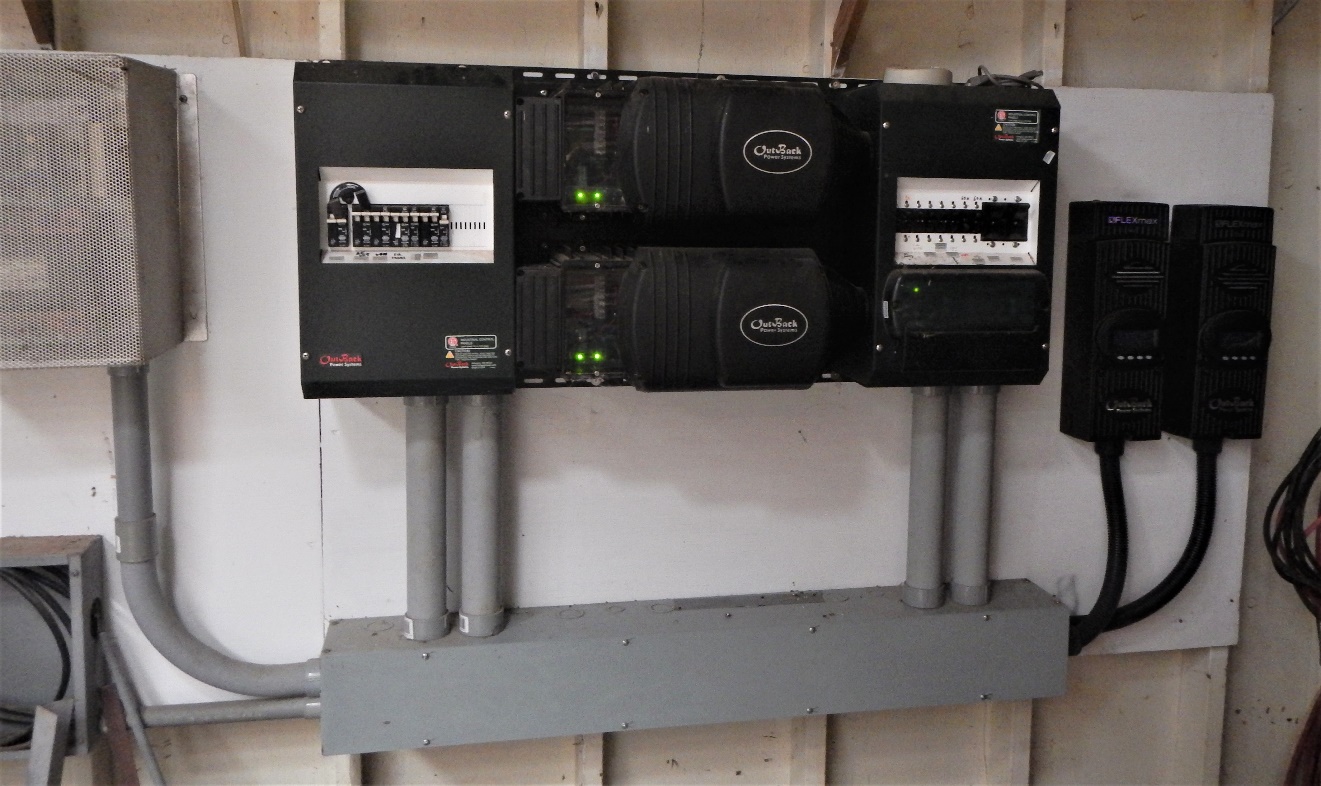
  • Two 80-amp MPPT solar charge controllers convert the solar output to 24 VDC for the battery.
  • 900 amp-hour lead-acid battery (12 cells at 2V each)
  • 4 kW inverter (2 Outback FX2024 operating in parallel at 120/240 VAC output)
  • 6 kW Northern Lights diesel generator

Inverters with solar charge controllers to the right

One half of 4 kW solar PV array.
The other half is on the roof of another building but looks identical.

Battery box 
(with concrete block to keep a visiting 4-year-old grandchild out), 
6kW genset, diesel supply in 55-gallon drum.

24 V battery
(12 Hawker flooded lead-acid cells, each 900 Ah)

24 VDC water pump inside concrete block enclosure

Solar hot water system with TV and Ham antennas behind.
80-gallon hot water tank is stainless steel.

240 VAC wood splitter runs off the solar electric system.

38,000-gallon water tank.
24 feet in diameter X 12 feet high.
Half the tank is underground.

The average solar incidence here in up-country Hamakua is low, only about 2.5 peak sun-hours per day. But with 4 kW of solar array, this is enough to average about 10 kWh per day, more than twice as much as we actually use. This means that we rarely need to use the back-up diesel to charge the batteries. Our average annual use of the generator is about 30-40 hours a year at a maximum charging rate of 2 kW. My estimate is that we use about 10 gallons of diesel a year in the generator.

The appliances serving the home are pretty typical except for refrigeration and water pumping. We have a washer and propane heated dryer, a propane range, propane back up water heater (rarely used since we also have ample solar water heating) the usual compliment of LED lighting and an assortment of communications and entertainment equipment (flat screen TV, a couple of computers, CD player and receiver), clothes iron, vacuum cleaner, bathroom appliances like hair dryer and toothbrushes, all being used at rates that would be typical in a grid connected house. We do power everything from power bars so that we can turn off equipment completely so as to avoid “ghost loads”.

Our refrigeration and water pumping are DC. This was originally for efficiency and power demand reasons, but over the years we have kept these appliances operating directly off the battery as a precaution against inverter failure. If the inverters fail, we can still have water and keep our refrigerator and freezer powered up. We would need to run the generator in the evenings two to three hours for light and for other electrical appliances, but it would save us from having to run the generator more often to keep the fridge cool and to pump water. Now that DC LED light bulbs are available, we may switch back to DC lighting, which would not be too difficult as the lighting load center is separate from the load center for the outlets (our lighting was originally DC).

Our water system is based on two corrugated steel tanks (including metal roofs) with heavy polyethylene liners. A 40,000-gallon main tank is filled with water from our roof and that water is pumped up to a 2,000-gallon tank about 100 feet higher than the house with a 24 VDC Shurflo pump. The little Shurflo pump only moves a couple of gallons per minute, but we only need to turn it on about once or twice a week for a few hours. (We have another piped water system with non-potable water for agriculture and livestock, but a description of that system is outside the scope of this post).

How much of these systems can we keep operating while adapting to collapse? In a collapse situation propane will be impossible to get. The clothes dryer can be abandoned totally to line drying (what we mostly do now), the back-up water heater can be shut down, and the range can be nursed along for a few months to a few years depending on the state of the 125-gallon propane tank at the time of propane delivery failure. For the longer term we have a wood cooking range on a covered lanai. This range would also be a source of hot water once I get the auxiliary water tank installation off my “to do” list.

So, the long-term energy sources for the house and farm are slated to be solar electricity and wood, with solar hot water for as long as the solar hot water modules last (perhaps 15 to 20 years). We have plenty of wood on the property and even have an electric wood splitter powered from the solar system. The wood range has a probable life measured in decades. We have a wood heater for those cool winter days (low 60s), but how to keep the solar system going?

The short answer for most of the power conversion equipment is to have plenty of spares. The inverters can be completely rebuilt with three circuit boards and a cooling fan for each inverter. Those parts are on the shelf. The inverters have been in continuous operation since 2006, so I expect them to need rebuilding in the next few years. The solar charge controllers have an estimated 15 to 20-year life and they are only about 7 years old, so with a spare for each the charge control system can last another 30-35 years. My current crop of solar panels is only about 5 years old, so they should last for a long time yet and I already have their replacements handy, since I bought another set for a second home that probably won’t get built after all. If we do finally build the second home, it will have a duplicate electrical system that can be intertied with our existing system, thereby increasing redundancy.

Here is a table summarizing the power system and the appliances operating from it:

Item

Estimated Life Span (Years)

Method of Repair

If Failure is Unavoidable

Solar PV modules

25-30

Replace with spares

Remove bad modules, rewire and use less electricity

Charge controllers

15-20

Replace with spares

Reconfigure PV to battery charging voltage and manually switch modules on and off (works only with flooded cell batteries)

Inverters

15-20

Rebuild with spare boards

Use DC appliances only or replace with legacy spare inverter (I have a couple of old Trace 2024 inverters in storage)

Battery

Wide variation

Replace with spares? Pick the battery with the longest possible life?

Use no electric equipment except any that can be operated directly off the solar array (DC motors, heaters)

Diesel generator

30

Have plenty of maintenance spares (belts, filters, etc.)

Greatly reduce electricity consumption in cloudy weather

Water pump

10

Replace with spares or rebuild with still-good parts from failed pumps

Haul water with buckets or install eave-level tank or install catchment roof at upper tank.

Corrugated water tanks

30-50

Reinforce weak areas with cables

Use any available vessel for water storage and hand carry water in buckets

Refrigerator

30

None

Evaporative cooling? Night radiation cooling?

Freezer

30

None

No frozen food

Washer

25

None

Hand wash with plunger. Have manual wringer on hand.

Propane dryer

30

None

Line dry everything all the time

Propane range

40

None

Substitute wood and wood range

Solar hot water modules

20

Substitute modules with spares?

Water heating loop in wood range

Stainless steel solar hot water tank

50

Move to wood range location

Batch heat water on stove

Household wiring

50+

Repair with spares

Live without electricity


Battery Considerations

Without an industrial civilization as backstop, the biggest hurdle to keeping a solar system going is the short life of the battery bank. My batteries have been well maintained, but they were three years old when I purchased them 8 years ago. They are nearing the end of their cycle life.

If it cannot be replaced by going to the nearest battery store, the main attribute a battery will need to have is the ability to operate over a large number of daily charge-discharge cycles. There are numerous comparisons of battery cost and cycle life on line. Most of those comparisons result in lithium-ion batteries being the best choice, especially if cost is not a determining factor, just because of their superior cycle life.

Many lithium-ion batteries are touted as having up to 10,000 cycles, even with 80% daily discharge. That would result in a life expectancy of 27 years even though they are typically guaranteed for only 10 years. Even though the cell chemistry could last as long as 27 years, my worry is that the sophisticated electronics that manage the charging of each cell in a lithium-ion battery will probably have a life expectancy of less than that.

I have not yet decided on a final battery replacement strategy. Here are some pros and cons for the best main choices (excluding price):

  • Lithium ion: proven long cycle life but delicate to charge and requires sophisticated electronic charge management system.
  • Lead-acid: Very forgiving if well maintained but have the shortest cycle life. It may be possible to store “dry charged” cells for many years before putting them in service.
  • Nickel-iron: Reputed to have a very long life and very forgiving of a simple charging system (similar to lead-acid). Very hard to damage except by using poor water for electrolyte replenishment. I am still not certain that the lifespan of this battery matches its reputation. Manufacturer literature suggests a cycle life between that of a good lead-acid battery and a lithium ion battery.

I am leaning toward lithium ion. I need to confirm the life expectancy of the typical battery management system and any needed protection from a solar charge controller failure.

I am also keeping an eye on the market for flow batteries for the home. These are quite new and have a limited track record, but should have very long life with easily replaceable pumps.

I am also tempted to see if I can craft build a pure-lead-plate battery from roofing lead sheet.

Conclusion

This post has covered a lot of expensive equipment, much of which my wife and I have acquired over many years. We feel very fortunate to have been able to do so. When one adds up the cost of a small parcel of decent farmland, a home and the outbuildings and equipment a small farm requires, including the equipment needed to provide electricity, water and heat for the home (including in-ground piping and electrical circuits) and other costs like livestock, fencing, roads, ponds, and land leveling, it becomes obvious that it takes a lot of money to prepare to eventually live without money.

I do know that the one thing that will always have value when adapting to collapse will be the skills it takes to help manage a small off-grid farm. Any person that has the ability to grow and hunt for food, manage livestock, operate energy and water systems and knows which end of a screwdriver to grab, is likely to find a place in a post-industrial-civilization world, even without a lot of money for preparation. I am still learning these skills and I started a long time ago. It’s past time to get started, so I recommend a crash course in practical trade skills to anyone that has few of them. Good luck to us all!


Wind and Hydro Power

Anticipating questions from our readers, I asked Joe about wind and water power. Here is what he had to say, which makes good sense to me. —Irv

I have had a small wind turbine as part of my array of battery charging sources and found it to be more trouble than it was worth. It was a Whisper 1000 and it really needed strong winds to produce much power. It also had a continuing series of mechanical problems, but I kept it going for a couple of years and then threw it away.

I have also had a lot of experience with the larger Bergey 10 kilowatt wind turbine on village power projects. It worked a little better than the Whisper but also required a lot of maintenance. Constant changes of blade leading edge protection tape, furling cable that broke and very high noise levels made it a pain to use. Now that solar modules are so inexpensive, I strongly advise against wind turbines except for large, grid-tied machines for commercial power producers.

Small hydro is another story. If a small stream with a reasonable head is available, small hydro can be a great charging source. I recommend going with a DC alternator to charge batteries and use an inverter for AC power. The small hydro system just substitutes for solar panels as a battery charging source.

If a larger stream is available, enough to generate the maximum power required at the site, then an all AC system can be installed. A load diversion governor is a lot cheaper than a variable geometry turbine. With a load diversion governor, the AC alternator is kept loaded at full output at all times and any unneeded power is electronically shunted to a waste load, typically a water heater element inserted in the penstock or a spa basin.

Small hydro is extremely reliable. The only difficult part is getting clean water into the penstock, which means that a lot of attention has to be paid to the intake structure and subsequent settling and screening equipment. Flood conditions put a great deal of force on the intake, so everything in the stream bed has to be very robust. The best small hydro sources are hillside springs, which avoid a lot of the issues with stream sources. Year around streams and springs are relatively rare, but if you have one they are great sources of energy. With enough head, it takes very little water to produce enough energy to power a homestead.


Irv again, with thanks to Joe. And now, just a few comments from me.

I agree very strongly with what Joe said in his conclusion about learning practical skills. If your work has you sitting in front of a computer pushing little bits of information around on the screen, and what you do for fun in you off hours never sees you touching a tool, it is time to start learning some of the skills that will be needed when BAU(Business as Usual) is no longer functioning.

Now back to the specifics of off-grid power systems:

One important thing to be clear about is that batteries don't like to be "cycled", that is, to be charged and discharged. Joe touched briefly on this, but I think it is important to emphasize.

Every time a battery is discharged and charged back up (cycled), it wears out a little bit and its capacity to store energy is reduced. The backup batteries that I maintained as an electrician in the power system were kept fully charged and only discharged during outages, and even then not too deeply discharged. They usually lasted for about 15 to 20 years.

In an off grid solar electric system, batteries are cycled fairly deeply on a daily basis. Joe estimates his current batteries will have a lifetime of around 11 years, which sounds about right to me.

The temperature where Joe lives ranges from the 50s to the 70s, Fahrenheit. This is, to say the least, less extreme than the temperatures we experience here in Southern Ontario ( -30° F to around 90° F.) And there are many places not that far north of here that get even colder in the winter. Precipitation around here also comes in various nasty forms in a addition to rain. Such as hail, freezing rain, sleet and snow.

This has some negative effects on solar panels, which are inevitably exposed to the weather, causing them to fail sooner. And of course their output is limited when they are covered in ice or snow.

Batteries function best when their temperature is in the 70s Fahrenheit. That means they need to be in a heated space in the winter. Lead acid and nickel iron batteries also need a well ventilated space due to the hydrogen created during charging and discharging. You probably wouldn't want them in your house due to the fire hazard. Lithium batteries don't given off hydrogen and can withstand more charge/discharge cycles, which is a major plus. But they are more expensive and required more complex charging controls.

I would appreciate hearing from any readers who are running solar electric systems with lead acid or nickel iron batteries in climates with cold winters.

I have some experience repairing battery chargers at the component level, but that equipment was built in the 1960s and 70s, used single layer, single sided circuit boards and discreet components rather than integrated circuits. It almost seemed as if it was designed with repair in mind.

Joe tells me that more modern equipment is less maintainable at the component level—about the best you can do is change out a whole board or module.

Acknowledging that, it still seems to me that there are quite a few people around who I would call tinkers, but who are currently referred to as "makers", at least some of whom have the knowledge, skills and equipment to salvage and refurbish/repurpose defective equipment when that becomes the only alternative. I think in some cases they will succeed in getting some extra life, maybe a few more decades, out of systems like Joe's. A way to make storage batteries using salvaged materials and a fairly low level of technology would be very helpful.

Finally, as Joe says, a system like his does not come cheap, and I suspect many of my readers will find themselves lacking the financial resources to set up anything close. And yet I've devoted this whole post to the idea, and I would recommend that those who can afford it should go ahead and set up such a system. Why so?

First of all, electricity is very useful and if you could extend it's availability by a few decades, it would be worth quite a bit to do so. In one's own domestic situation electric lighting, refrigeration and water pumping would be worth a lot, along with communications and entertainment.

Secondly, in the years after the grid finally fails us, I would like to think an attempt will be made to switch over to sustainable, "village level" technology and to utilize local energy sources to generate electricity. This transition would be greatly facilitated by off grid power systems of the type Joe describes.

A closer look at this transition and the positive legacies of the industrial world will be the subject of my next post.


Links to the rest of this series of posts, Preparing for (Responding to) Collapse:

Thursday, 19 September 2019

Responding to Collapse, Part 12: coping with longer power outages

Volunteer butternut squash and gourds
that grew from one of our compost bins this year.


Dealing with power outages, Section 2

This is the second of the four sections I promised in my last post where I talked about the most basic preparations you should make for short power outages.

Today we'll talk about some further preparations that you can make that aren't (for the most part) terribly expensive and which will help see you through longer outages. There are some pieces of camping equipment that can be quite useful when the grid temporarily lets you down, and useful for camping, as well. This still comes under the classification of coping with a failing BAU (Business as Usual), rather than adapting to a failed BAU.

Because camping often takes you out of contact with the power grid there is a range of camping equipment that uses energy sources other than electricity or allows you to generate your own electricity. When camping, or during an outage, you want to use as little electricity as possible, so that the equipment you need to generate it is as small, simple and inexpensive as possible. Electrical appliances that turn electricity into heat are the first thing you want to get rid of in favour of using some sort of fuel directly to produce that heat. Things like furnaces, heaters, stoves, toasters, and so forth.

Two different type of small propane cylinders
and a can of Coleman fuel

The fuels you'll most likely use are either propane gas or white gasoline (also known as naphtha or Coleman fuel). You can easily store enough of these fuels to get you through an outage a few day to a couple of weeks in length. There is quite a bit of discussion on the internet as to which is better, liquid fuel or propane. All the camping equipment I have uses liquid fuel, which costs less, is less bulky, is safer to store, handle and move in a vehicle, and works better in the cold. It is a bit more complex to use. I do have a propane barbeque and a propane torch for soldering and such.

I keep two or three cans of Coleman fuel on hand, and I've read that as long as the can hasn't been opened it stores quite well. I've left fuel in partly empty cans (with the cap closed) for years and then used it with no problems, so I'm not sure how much of an issue stale fuel really is.

The choice between liquid fuel and propane gas is largely a matter of personal preference. If you go with liquid fuel, have a funnel on hand for filling and a spare set of guts for the air pump. And the one thing you must not do is to fill Coleman appliances with liquid fuel indoors. That's asking for a fire. Make sure you go outside to a well ventilated area with no nearby sources of ignition.

There is also a lot of discussion on whether it is safe to use this equipment indoors, much of which is pure bunk. For safety's sake crack a couple of windows to get some ventilation and have a carbon monoxide detector in the area where you'll be using the equipment. I have found when using even a small appliance like a mantle lantern indoor in the winter that it generates enough heat to make up for the loss from windows that are slightly open.

At this point I should address the issue of natural gas. Many of you probably have a natural gas supply connected to your house. You'd think that this supply would be unaffected by electrical outages. Sadly this is unlikely to be true. In the majority of cases, that natural gas supply is pressurized by electrical pumps that won't be working during a power outage. Some large trunk lines are pressurized using pumps powered by natural gas, and I am told they will probably continue to work during a power outage. But their controls are probably electrical, and unless they have battery backup and/or a backup generator, they won't work either. So I wouldn't rely on your natural gas supply to be impervious to power outages. In any case, most of your natural gas appliance have electrical control and ignition, so they won't work during an outage. Unless you have a generator (see more below).

Perhaps some of you have propane appliances supplied from a large tank that the propane company installed next to your house, and which they fill regularly. This is a source of energy that may well carry you through a power outage. As with natural gas appliances, most propane appliance have electrical controls and ignition, so you need a generator, or a way of hooking you camping style propane appliances up to that big tank. There are a couple of other concerns. Most propane companies work on just in time delivery and if your tank is almost empty when an outage happens, your propane supply won't last long. Perhaps you can talk you propane supplier into a different delivery arrangement. And during high use periods like cold snaps the local supply of propane may run out and you won't be getting any deliveries, even if the power is on.

At this stage you probably still don't want to make majors changes to your lifestyle—when the power is out, you'd like to be able to have some electricity, for a variety of uses that aren't easy to power with other energy sources, or to provide control power to appliances that burn natural gas, propane or even fuel oil.

If you just want a small amount of power, there are small battery banks which store enough power to recharge your phone, tablet or even your laptop. The simplest ones can only be recharged from 120V AC, but the more sophisticated ones (know as solar generators) can be recharged from a solar panel, 12V car outlet, or 120VAC, and they sell foldable, portable solar panels which will charge these battery banks. They have power outputs at 120V AC, 12 VDC and powered USB ports for phones and such like.

I don't have one of these devices, so I can't speak from personal experience, but while they do appear to offer a certain degree of convenience, they are quite expensive and they really don't store very much power—a few amp hours at the most. Certainly not enough to run typical refrigerators or freezers, for instance. If you want to go with solar power, you might be better to consider the full fledged solar panel, inverter-charger and battery system that I'll be discussing in my next post.

Generators

Our Generator

The obvious thing here is to get a generator. I finally gave in and bought a generator a couple of years ago, and last fall we installed a wood stove. We have electric heat and it just isn't practical to have a large enough generator to run our electric furnace, so the two decisions went together.

Our generator is a gasoline fueled, 5500W model made by Champion Global Power Equipment that we got on sale at Canadian Tire for less than $1000 Canadian. (Canadian tire is a chain of automotive/hardware/houseware/sports/garden stores here in Canada. If you live outside Canada don't know what you are missing.) If I had deeper pockets I would have gotten a Honda generator—in my experience Honda power equipment starts more easily, is more reliable and lasts longer, but also costs a lot more. So far the Champion has started easily and run well, even in the winter. This was the smallest generator I could find with a 240V output, needed to run our furnace fan and some of my woodworking equipment.

Some may wonder why I didn't get an "inverter-generator", which uses a DC generator and solid state invert to produce AC. They offer better fuel economy if you want to run your generator pretty much continuously and under light loads most of the time. And they usually are set up to run quite quietly for use in campgrounds. But they are more expensive and more complicated. I intend to run my generator only when there is really something for it to do, and I needed to get the most bang for my buck.

Draining stale fuel form generator
into spare jerry can.

On the left, two jerry cans full of gasoline.


Generators do require some on-going effort to keep them in good condition. I start ours once a month and run it for a short while, then shut off the fuel valve and let it run dry so as to stop fuel from leaving deposits in the carburetor. Fresh fuel is also very important. I have three 20 l. (5 gallon) jerry cans, two of which I keep full of fuel. Before running the generator each month, I drain its fuel tank into the third jerry can and empty that can into my car's fuel tank. The other two cans are labelled "odd" and "even" and in odd numbered months I empty the "odd" can into the generator and then fill it with fresh fuel at the gas station. Same for the "even" can in even numbered months.

Like most generators, this one will run about 8 hours at 50% load. My jerry cans hold the same amount of fuel as the generator's fuel tank, so I'm good for 24 hours at half load. Of course, most of the time I'll to be running the generator at less than 50% power and I have no need to run the generator round the clock, especially with the wood stove and Coleman equipment. I expect that during an outage I would run the generator for an hour or so morning and evening to cool down our freezers and fridge, and do anything else that I need power for at those times. So I hope to be good for outages up to a couple of weeks long.

I got a gasoline fueled generator because my car uses gasoline and I can rotate stale fuel into the car rather than throwing it away. And during an outage, if I desperately have to go somewhere and gas stations aren't operating, I have some spare transportation fuel on hand. If you have a diesel vehicle or you live on a farm with diesel equipment and have a big tank of diesel fuel in your equipment shed, you should consider a diesel generator. If you have propane appliances already and a large tank of propane that your supplier fills regularly, you might want to consider a propane fueled generator.

I just googled "does diesel fuel get stale" and apparently it does after a few months, so you'll still need to rotate your diesel fuel. This will be much less of an issue with propane.

There are a few other complications with owning and using a generator that we should discuss.

Some maintenance will be required, such as changing the oil regularly (check the owner's manual for how often) and cleaning or changing the spark plug. And eventually you'll want to take that generator to your local small engine place for a complete overhaul.

Because the gas tank is full of fuel, a generator is a fire hazard and you shouldn't keep it in your house. I keep mine in my backyard tool shed.

When it is running, the exhaust is a problem (carbon monoxide and so forth), so it should be run outdoors or the exhaust vented outdoors, and not upwind of any ventilation intakes.

Because this is a piece of electrical equipment it needs to be kept dry, and this includes keeping it dry when it is running outdoors in the rain. A leanto made with a trap and some 2X4's would do in a pinch. Or you might want to build a very well ventilated shed to both store and run the generator.

Hooking your generator up to the electrical system in your house in a way that is safe and meets the requirements of the electrical code is a job for an electrician. Until that job is done, you can hook up individual loads to the generator with extension cords. Using a cord with two male ends to plug your generator into the house system is dangerous and illegal. The main concern is that if you leave your main breaker or switch closed, you'll be livening up the whole grid and the people who are working on it trying to restore power. It is no exaggeration to say that that deaths can result from this.

My generator is quite noisy and I don't plan on running it through the night. You can get generators that run fairly quietly, but they are more expensive and usually come in smaller sizes, so I chose not to get one. During an outage, that noise is going to attract attention. In the little town where I live, I expect my neighbours to drop by and see if I have power. When outages become more common, I expect we'll develop a tradition of generator parties, and I'd be pleased to host one.

I hear American survivalists and preppers talking about noisy generators attracting unwanted and possibly dangerous company. They'll probably shake their heads and laugh at my idea of a generator party, but things really are different here in Canada. As my American daughter-in-law, who grew up in Camden, New Jersey, and lived in Jacksonville, Florida, before coming here, says, "it's like moving to a different planet."

Single Mantle
Coleman Lantern
Spare mantles on the right.

OK, having covered all that information, now let's run through our list of services with all this in mind.

Lighting

You can get battery operated lanterns that are quite effective, but I would advise getting a Coleman mantle lantern. They generate a bright white light that is barely distinguishable from the electric light we are all used to and give off a fair bit of heat as well. The mantles are fairly fragile when in use, so keep a couple of spare mantles on hand. Kits of repair parts for the air pump on Coleman appliances are available and you should have one.

Water

Additional water storage would be a good idea, enough for a week or two, at minimum of a gallon per person per day. For two people for a week that's 14 gallons. The next step after storing more water is to have a water filter that can make surface water safe to drink. If you live near a lake, pond or stream, this will prove usefull.

Google will give you links to many types of water filters, but if you are looking for a tabletop filter that will turn the most unsavory surface water into something drinkable, Berkey or Doulton are the brands you want.

Filter elements
inside the upper bucket
Our homemade water filter

They are a little pricey, though, and it is possible (I have done it myself) to put together a much less expensive DIY filter using a pair of plastic buckets that is functionally equivalent to the factory made filters, and uses the same filter cartridges. Here are a couple of links to instructions: 1, 2.

It is also a good idea to keep some 5 gallon plastic buckets on hand for carrying water. You'll find they actually come in handy for a great many purposes.

There are a variety of water treatment/filtration systems for use when camping or backpacking. I'm not really up to speed on these, so I'll include this link to a review of Best Backpacking Water Filters & Purifiers of 2019 to start you on your own research if you are interested.

Of course there are filters you can make at home using charcoal and sand, but I'm going to leave those for my next post.

If you have a well and a generator, best call your electrician and see what is going to be involved in powering your water pump from the generator. Many water pumps have a 240V motor, so you'll need a generator with a 240V outlet, a suitable extension cord, and some wiring at the pump to make it safe and easy to hook the generator up to it.

"Jenkins" Style Sawdust Toilet
with bale of wood shavings in front

Sewage

What I said in my last post applies here as well. Keep an emergency bucket toilet on hand, or go for a Jenkins style sawdust toilet . I have one of them tucked away in a secluded corner of my basement woodworking shop. If we were going to use it regularly, some ventilation to the outdoors would be needed.

I can recommend a couple of books on the subject of humanure: The Humanure Handbook by Joseph Jenkins, and The Scoop on Poop by Dan Chiras.

Food

I'm going to leave the issue of storing large quantities of food for a post in the near future where I'll discuss the ongoing availability of diesel fuel and its effect on supply chains. But it is a good idea to have enough food on hand to last two weeks at a bare minimum, assuming that many stores won't be open and regular deliveries won't be happening during an outage. The idea here is to store what you eat and eat what you store. Don't get taken in by those people who are selling expensive freeze dried emergency food.

Some of that food may end up getting served at a generator party, so plan accordingly.

Two burner liquid fuel Coleman stove, and large kettle

If you are in the habit of always eating out and don't normally keep much food in the house, you need to break that habit and learn how to cook as part of your collapse preparations. It is likely that most restaurants won't be operating during an outage.

The first long outage will catch a lot of people, both consumers and those working in the supply chain, by surprise. A rude awakening, but one that may lead to better preparation for future such problems.

Cooking

You won't want to subsist for very long on food that doesn't need to be cooked. I would recommend a two burner Coleman stove to use when your electric range isn't working. If you have a propane stove that will work without power you're in luck. Propane barbeques can also be useful when the power is out.

Spare parts for Coleman pumps

I recently acquired some spare parts for the pumps of my Colman lantern and stove. The cup on the right is made of leather and will work at much lower temperatures than the usual rubber cup, which stiffens up in the cold.

A big kettle for heating water for washing is also handy.

Refrigeration

At this level of preparation, refrigeration is a tough issue. My own response was to get a generator and plan to run it for short periods a few times a day to keep our fridge and freezer cold. Freezers will stay cold for a day or two without power (especially if they are full), but refrigerators only stay cold for about 4 hours without power and I expect to keep several bags or plastic bottles of ice in my fridge to extend that time (so I can get a full night's sleep if nothing else). I'm also shopping around for a "fridge thermometer" so I can tell how that's working.

There are refrigerators intended for off grid situations that are better insulated and take less power than typical fridges. And there are propane powered refrigerators of the type used in RVs. Both are pretty expensive, so I'm not seriously suggesting you get one at this point.

It is possible to turn a horizontal chest freezer into a refrigerator that takes very little power and stays cool longer. When you open the door, the cold air doesn't fall out, and they have thicker insulation than a regular fridge, so they stay cold longer and use less power. This would be particularly useful if you are setting up an off grid solar power system and need to keep your power usage to an absolute minimum but still want to have refrigeration.

Here are some links to instructions: 1, 2.

The only criticism I would make of these instructions is that it is pretty dumb to run the capillary tube for the sensor bulb under the door seal—hard on the door seal, and leaky. Instead, you can get the temperature sensing bulb in into the fridge through the drain valve and put some duct seal (industrial strength plasticine) around it for a good seal. The "old school" mechanical temperature controller shown in both those articles is definitely the way to go since it uses no power itself. Sometime ago I read another article where the author had gone to a lot of trouble to build an electronic controller that used less power than the fridge. It still used a bit of power, though—better to stick with the simple mechanical controller.

Awnings on the south side of our house

Cooling

As I said in Part 1, if you've chosen your location carefully, you should be able to get by without air conditioning, and just suffer through the few hottest days in summer. Shade and ventilation will help, and believe it or not, if you stay out of air conditioned spaces for a few days , you will get used to the heat. Try to take it easy though, until you've adapted.

Shade can be provided by trees and/or awnings. Trees take a while to grow, so it's best to look for a place that already has shade from tall deciduous tree, definitely on the south side and if possible on the west side. Or plant quick growing trees like mullberries, and wait patiently.

My house has lots of south facing windows from solar gain in the winter, but that's not a good thing in the summer. And it is in a location without trees and where planting trees isn't really practical. So I made up awnings to shade the windows that were picking up the most heat in the summer. They have to be put up in the spring and taken down in the fall, but it's worth the effort.

Guts of attic vent,
based on salvaged furnace blower
Attic Vent Grill

A well designed house can get quite a bit of cooling from natural ventilation, especially from cool breezes in the evening. It helps to have windows that open. This still just wasn't enough for our house, so I put in an attic fan which draws air in through the windows and pushes it out through the attic vents, cooling both the house and the attic in the process. This works best when it cools down after dark, which it usually does in our area.

Our wood stove

Heating

We have an electric forced air furnace, so when the power is out, we have no heat. We do have a catalytic tent heater that uses liquid Coleman fuel. It works pretty nicely in a tent and does OK in the house in a pinch, but it would be best to do the initial lighting outside and you really have to open some windows for ventilation.

There are space heaters that burn propane or kerosene and apparently are safe to use indoors and don't use electricity, or at least work OK on batteries, and aren't terribly expensive. Something to look into if you really don't want to get a woodstove, or simply can't afford one.

But perhaps it would be best to just get a wood stove. Especially if wood heating is common in your area, and there are people making a business of installing wood stoves and supplying firewood.

We did that last fall, and while it was a major expense (especially the chimney—we have a tall house), wood is still cheaper than electricity, so it will pay itself back over a number of years. Of course, there is a bit of work involved in tending a wood stove, but it seems worth it to me. Though I must admit that I am retired and often looking for something to do in the winter.

Our very tall chimney
Ten cords of firewood ready for this winter

Communications

You should make arrangements for communicating with your family (and other house mates) who may be away at the start of an outage. Cell phone will be working for 2 to 4 hours and landlines for quite a bit longer than that.

It appears that CB radio is no longer a big thing, but amateur (ham) radio is. For those who are so inclined I would suggest taking up ham radio and joining a group who use their two way radios for emergency response co-ordination. Not for everybody, clearly, but a fun hobby for techies who like to talk to strangers.

Transportation

I don't have much more to say here than in the first section. Keep you vehicle's tank at least half full, and in a pinch you can use some of your stock of generator fuel in your car.

Bicycles are useful, even when the power is on. I have to admit that living in a hilly town I lust after a bicycle with electric assist, which could be charged by generator or maybe even by a solar panel if you don't plan to use it too much.

And of course, in a small town, walking is quite practical and something we should all get more accustomed to doing.

In Closing

Quite a bit of what I've advised here is not expensive and can be done even by apartment dwellers or if you are renting a house. Much of it would probably be a good idea even if you aren't preparing for collapse. And it will allow you to get through longer and more frequent power outages with relatively little suffering. But best not to kid yourself that this will give you much in the way of long term independence from BAU. We tackle that sort of preparation in my next post.


Links to the rest of this series of posts, Preparing for (Responding to) Collapse:

Sunday, 25 August 2019

Responding to Collapse, Part 11: coping with power outages, the basics

Storm moving in off Lake Huron, August 2019

In my last post I talked about some of the problems with using "for profit" companies to provide infrastructure services and went on to look at how one major part of our infrastructure—the power grid—is likely to gradually fail over the coming years. I ended up looking at the effects of power outages, but ran out of space to cover how you can mitigate those effects and what your community can do to cope when it finally finds itself permanently isolated from the grid. I'll start talking about that today, but it looks like it's going to take three or four posts to cover this subject in the detail it deserves.

If you're following or considering following the suggestions I've been making in this series of posts, you're probably receptive to the idea of making preparations for collapse—possibly quite eager to get at it. The endgame here is the end of industrial civilization, with the grid shut down completely and the wells, mines, farms and factories it supports no longer running. So, you might think it would be a good idea to just dive in right now and go off grid.

In general, though, when preparing for any of the effects of collapse, it is important to remember kollapsniks like me have a pretty bad track record when it comes to attaching dates to our predictions. So the shape of your preparations should be such as to not squander your resources and leave you broke or in debt when the apocalypse doesn't happen a week from Tuesday. Ideally your preparations should enhance your life as BAU (business as usual) continues to gradually wind down, as well as making it possible to get by when BAU is finally gone. Which may be quite a way down the road as yet.

When most people talk about going off grid, they are talking not about doing without electricity but about generating some of their own, in order to maintain a certain level of modernity in their lifestyle. To do this requires access to two things: an energy source or sources and technology that can convert that energy into electricity. It is also helpful to be able to store the electricity you generate if your energy source is intermittent.

Today's consumer society makes energy sources, generating equipment and batteries readily available. This, unfortunately, will involve a significant upfront investment, the electricity you produce is likely to be more expensive than the electricity you can buy from the grid, and you won't have really gained any long term degree of independence from BAU. If you can afford it, this may be one way of setting up to weather power outages with a good degree of comfort and convenience. I suspect, though, that many of my readers are not wealthy enough to spend many thousands of dollars on an off grid power system.

It is probably true that at some point, as grid power increases in cost and decreases in reliability, home generated power becomes a winner. But at that point you'd also like to become much more independent of BAU, so a different approach will be required, and whether you can arrange to have electricity at all without relying on BAU for fuel, equipment or spare parts is a serious question. Which I'll get into in a post just a little way down the road.

But first, let's get back to the issue of coping with power outages. The effects of such outages, especially longer ones, are so far reaching that it is overwhelming to think of coping with them all. So I'll just concentrate on the most immediately impactful: lighting, cooking, refrigeration, food, water, sewage, heating, cooling, communications and transportation. Not necessarily in that order.

I'm going to divide the rest of this into four sections, each of which deals with a different sort of response to the challenge of power outages, roughly speaking in increasing order of expense and personal commitment. The first of those sections will be covered in the rest of this post and the final three in my next few posts.

I am assuming that many of my readers are convinced enough of the inevitability of collapse that they already have or are seriously considering moving to a remote small town and are eager to do some preparation, but they may be limited in their financial resources and practical skills. Sections 1 and 2 will cater to those limits.

1) Short Outages, minimal response

In the case of short outages, you can simply do without for a few hours, and experience little more than minor inconvenience. Indeed, the most important technique I can recommend for coping with any of the effects of collapse is to be ready to cheerfully accept some loss of comfort and convenience.

Around here, minor outages used to last from 2 to 4 hours. Now it's more like 4 to 8 hours, which is almost entirely due to power companies trying to save money on staffing. Most of us have lived through a few of these, especially in rural areas where power is distributed via overhead lines strung on wooden poles. This is, realistically, part of living in an industrial civilization—the cost of eliminating all outages would be too high.

So kick back, read a book and wait for the power to come on. Of course, if the power is still off after sunset that book is going to be hard to read, and it sure would be nice to have a flashlight and/or some candles. A little more thought and you'll soon realize that there are a few things that aren't terribly expensive and which would make short power outages much less of a nuisance.

Even people who don't accept the "collapse narrative" will benefit from some basic preparation of this sort. At this point (August 2019) all the resources of BAU are still available to consumers, so everything you'll need can be had very easily.

Lighting

Flashlights and batteries

In the short run, the lost of electric lighting is one of the main things to prepare for and also one of the easiest. You don't want to be stumbling around in the dark as you do the things you'll want to do to cope with an outage. And once that's out of the way, you're going to find it pretty boring without all the electronic entertainment you're used to. It takes light even to enjoy books and board games. At this basic level, you'll use flashlights and/or candles to provide light.

Flashlights have improved a lot in the last few years. LEDs have replaced incandescent bulbs, increasing battery life and making flashlights much sturdier. These days the best batteries have a shelf life of around 10 years, so that you can leave your flashlight sitting on a shelf for a long time and not end up with dead batteries or a corroded mess. And I guess if you plan on using a flashlight a lot, one with rechargeable batteries would be a good idea. One useful variation on that idea is a flashlight with rechargeable batteries and a built in hand cranked generator.

In emergency situations, a flashlight is especially handy when you need to move around in the dark. They also don't present a fire hazard the way candles do.

In the photo on the right are the flashlights found around our house and car, all of which were purchased at Canadian Tire. (Canadian tire is a chain of automotive/hardware/houseware/sports and garden stores here in Canada. If you live outside Canada don't know what you are missing.) At the back is a worklight that takes 4 AA cells and produces a startling amount of light for along time. Comes with a hook to hang it by and magnets in the base to stick to any iron or steel surface. In the middle is a Garrity handcranked flashlight. Thirty seconds of vugorous cranking gives you 3 to 5 minutes of light, depending on how dim you're willing to let it get before cranking it up again. At the front on the left is the Maglite single AAA flashlight that I carry on my keychain. Put out 47 lumens. Second from the left at the front is the Maglite 2 AA flashlight that we keep in the glove box of our car. Puts out 97 lumens. On the front right is a cheap 3 AAA flashlight that only puts out 60 lumens.

Candles and holders, matches and lighter

Candles are good too, especially as a stationary source of illumination. Unfortunately most candles don't come with built in holders and being tall and skinny, don't stand up very well on their own. So it is a good idea to have a few candle holders around the house, sized to fit whatever kind of candle you keep in stock. In the front right of the photo to the right is a tea light, which comes with a built in holder and doesn't take up much space. Useful in emergency bags.

Since candles don't light themselves, you'll need matches or a lighter of some sort. Nobody smokes in our family, so the lighter we have is made for lighting barbeques, but works fine for lighting candles and our woodstove as well. The long nose keeps you hand back a bit from whatever you're trying to light.

Water

Water storage in the cold room at our house

Water is your next most urgent need. And while the municipal water supply or your own pressure system may continue to supply enough water for drinking and washing for a short period, it is wise to have a few gallons of potable water stored away. It is usually recommended that you have one gallon per person per day just for drink and washing.

Water from a chlorinated municipal water supply does not need further treatment when stored in clean, food-grade containers. Non-chlorinated water should be treated with bleach. Add 8 drops of liquid household chlorine bleach (5 to 6% sodium hypochlorite) for every 4 litres (one gallon) of water. More details can be found here and here.

I'm not, by the way suggesting you go out and get a few cases of bottled water in single use 500 ml plastic bottles. First off, if you can't drink your tap water, you're living in the wrong place. Second, bottled water is an expense you should avoid. Third, those bottles are a serious waste problem. If you're strapped for cash, save food grade plastic containers that you would otherwise throw out, wash them and use them to store water. Things like 2 litre beverage bottles, juice bottles, and so forth. And if you can afford a relatively small investment, you can easily get sturdy purpose built water bottles that hold 20 litres (5 gallons) and have a built in spigot. In the photo above there is also a blue 2.5 gallon water container from Canadian Tire that we use when travelling.

Our 60 gallon
electric water heater

Another source of water is your water heater which probably holds 40 or 60 gallons of potable water. If it's never been flushed then the water at the bottom, which will come out first, will probably be rusty. The drain valve is also probably very close to the floor, and you likely need a screwdriver or wrench to operate that valve. Best to check this out in advance and make sure you have the required tools and a pan that will fit under the valve to catch the water. In any case it's also a good idea to flush your water tank annually.

Sewage

Safe handling of human waste is an important public health issue. And when you gotta go, you gotta go—it really is an emergency. Even during a short power outage, the odds are that someone in your home will need to use the facilities.

You probably have a flush toilet hooked up to a septic tank and weeping bed or to municipal sewers. The septic tank and weeping bed is likely gravity fed, so it is OK to use the toilet even when the power is off. Municipal sewers may be gravity fed, but it is likely that some parts of town are downhill from the sewage processing plant and rely on electrically powered pumps to make things flow in the right direction. I live in such a location and the town used to show up with a vacuum truck during outages and use it to make sure that our sewers didn't back up. Recently they installed some upgrades, including backup generators for critical sewage pumps. It wouldn't hurt to check into the situation in your town.

Your toilet is good for one flush using the water in its tank. If you've made no other preparations, you need to make the most of that flush, and not waste it when there is nothing more than urine in the bowl. Then you need to be looking for a source of flushing water, which you can just pour into the bowl to make the toilet flush. Many sources of water that you wouldn't want to drink are fine for flushing a toilet. The rusty water from the bottom of your water heater is certainly OK, as is rain water and surface water from streams and ponds. A five gallon (20 litre) bucket is useful to have if you are reduced to scrounging flush water from such sources.

Emergency bucket toilet
with waste bags

People like me, who grew up on farms and have spent some time in the bush, are not above finding a secluded spot outdoors to urinate, and in a pinch even to defecate. Though it is important to realize that feces are a health hazard to other people using the area. This brings us to the idea of emergency toilets which you can put together quickly. Here are several good articles on the subject:
How to create an emergency toilet
Make and use an emergency toilet

Amazon will be glad to sell you a bucket, seat, lid and waste bags, all ready to go. Or you can buy just the seat, lid and waste bags, and supply your own bucket.
Portable Toilet Bucket with Seat and Lid Attachment

I would recommend having one of those emergency bucket toilets on hand. I don't have one because I have a Jenkins style sawdust toilet made up and ready to go for emergency use. These are often called composting toilets, but only because when the bucket gets full you can dump it in your compost pile. The legality of doing that with human waste varies from place to place, so it is best to be discreet.

Food and Cooking

During short outages you can either go hungry for a few hours (it won't kill you) or have some food on hand that can be eaten without cooking.

Refrigeration

Your concern here will be that food in your refrigerator don't spoil and frozen food in your freezer doesn't thaw.

Food in your refrigerator should be OK for up to about 4 hours provided you don't open the door too often and let the cold air out. If you freezer is full, food should be safe in it for about 48 hours, 24 hours if it is half full. If your freezer isn't full, it is a good idea keep some ice in it for increased thermal mass. I use several jugs of water, which freeze after they are put in the freezer. It might also be a good idea to open the door of your refrigerator just once and put in a jug or two of ice from your freezer.

Some good advice on keeping food safe during an emergency can be found here.

Frozen food that still has ice crystals and feels cold is usually safe to refreeze. Frozen food that has thawed out, and food that normally requires refrigeration, and has been above 40 degrees F. for more than 2 hours, should be discarded.

Heating and Cooling

If you've chosen your location carefully, you should be able to get by without air conditioning, and just suffer through the few hottest days in summer. Shade and ventilation will help, as will moving heat generating activities like cooking outdoors. And believe it or not, if you stay out of air conditioned spaces for a few days, you will get used to the heat. Try to take it easy though, until you've adapted.

Here's some good advice on how to stay comfortable and safe during hot weather.

The same careful choice of location will, unfortunately, put you in some pretty cold weather in the winter. If your home is well insulated and well sealed it shouldn't cool things off more than a few degrees during a short outage.

But just in case things get worse than that, here's some good advice on keeping warm in a winter weather emergency. The basic idea is to limit the spaces you're trying to heat, and whenever possible to heat humans, not spaces.

Communications

Handcranked and battery operated radios

You may want to call the power company to let them know about the outage and to contact family and friends to see if they need help. Your cell phone, if it is charged up, will probably work through a short outage as will your land line phone. But if your landline phone is a cordless one, it won't work unless there is power to the base station, so get at least one old fashioned directly wired phone and make sure it works if it is not connected to a power source.

A battery operated radio is also a good idea, for both information and entertainment. The handcranked radio on the left (a Grundig FR-200) in the photo to the right inlcudes a flashlight and receives AM, FM and 2 shortwave bandsworks. It work off 3 AA cells as well as the buildin rechargable battery. Sadly, the quality of the souond is poor, and it doesn;t discriminate between closely adjacent stations very well. The small Sony boom box onthe right takes 6 D cells and works just fine off them or 120VAC. The sound quality is great and it plays cassette tapes and CDs as well as AM and FM radio.

Transportation

Personally, I would advise staying off the roads during a short outage. Traffic lights aren't likely to be working and those who are on the roads may be panicky and not thinking straight. But just in case you do have to go somewhere, it's a good idea to keep your fuel tank at least half full. That's a good idea in any case, really.

Miscellaneous

If you work at home using a computer losing unsaved work in the event of a power outage can be expensive. Of course a laptop with a good battery will allow you to save your work before shutting down. If, like me, you are still using a desktop computer, a UPS (uninterruptible power supply) is a really good idea.

When the power comes back on the voltage is likely to be quite low due to heavy loading. This can cause problems for voltage sensitive equipment like motors and electronics. You can do your part to help with this problem by turning off heavy loads such as your electric furnace or baseboard heaters in cold weather or air conditioners in hot weather, and also your water heater, stove and clothes dryer. And to be safe, disconnect sensitive equipment like refrigerators, freezers, computers and televisions.

In Closing

You can make these few, simple preparations even if you're living in an apartment where you can't make big changes to the infrastructure. And it won't cost you very much, either. Everyone should have these basics under control.

But I would guess that along with a few short outages the immediate future holds the possibility of one or more substantially longer outages, which will do much to change our complacent attitudes and render us eager to be more prepared.

In my next post I'll cover a higher level of preparation, still achievable on a tight budget and still relying on BAU for supplies and equipment, but suited to coping with longer and more frequent outages.


Links to the rest of this series of posts, Preparing for (Responding to) Collapse: