Showing posts with label Overshoot. Show all posts

Wednesday, 25 October 2023

The Porcupine Saga, Part 6, The Sign Above Our Gate

Allan Harper, later on Tuesday, April 9, 2030

Allan Harper left the old farmhouse and walked across the yard to the big pole barn where they'd been piling everyone's stuff as it came in, ready to be sorted out and distributed. It was getting dark, but a "dusk to dawn" light on a wood pole illuminated the area, and he easily made his way to the person-sized door in the east wall of the building. Entering, he called out, "Dad, you in there?"

"Yeah," Tom replied, "I'm back this way."

Allan picked his way between piles and found his Dad seated at a table which held an elderly desktop computer and a big printer. Behind him were several tables of seedlings with grow lights above and heating pads underneath. Tom had been working on them for the last few weeks—the pole barn was not, strictly speaking, heated, but it had been a warm spring thus far and the plants were doing well.

He nodded to his father and said, "I guess I owe you an apology."

"Maybe so," said Tom, turning away from the computer so he could face Allan. "I gotta tell you that 'fascist' shit cuts pretty deep."

"Yeah, I can see that," said Allan. "So, sorry. But...well, a lot of what you say really does sound fascist to me."

"I am puzzled by that," said Tom, "I've spent a lot of time, on my blog and on social media—even in person, sometimes—helping people identify fascism and talking about what is wrong with it. As I understand it, the two essential things about fascism are: one, a belief in inequality, that some people are significantly better than others, and we would do well to let those superior people lead, and two, that there is an essential identity, often based on race, that characterizes that elite. Right?"

"Sure," said Allan, "no argument there. But there are other elements to fascism, and eco-fascism is one of them. Whenever you start talking about over population as the world's main problem, you set off my 'eco-fascist' detector."

"I think there must be a little more to it than that," said Tom. "Eco-fascist are by definition right wing, which I am certainly not, and they are against immigration, which I am also not. As I was reading just now on Wikipedia, they 'embrace the idea of climate change as a divinely-ordained signal to begin a mass purge of sections of the human race', which I certainly don't agree with."

"So you say," said Allan, "but then you go on and make a liar of yourself."

"How so?" asked Tom, with a puzzled look on his face.

"Well," replied Allan, "you brought up the ideas of carrying capacity and overshoot—overshoot by 170%, I think you said—which implies mega, or maybe even giga, death, and mainly in the third world countries. All very handy for an eco-fascist, who would love to see all those poor, brown people gotten rid of. Environmentalism through genocide, it's been called."

"But I don't think overpopulation is our main problem," said Tom. "And I am not suggesting that we get rid of anyone. Maybe you need to look at little deeper into what I really am saying. Will you give me a chance to explain?"

"Sure," said Allan, "go for it. And you can start with this thing about overpopulation not being the problem—it's seems to me that it follows obviously when you start talking about carrying capacity and overshoot."

"Well, I've met a lot of people who do indeed think that connection is obvious," said Tom, "but I'm not one of them. I think you and I need to talk more about carrying capacity, but first we need to consider the other side of the calculation—the idea of impact. If our impact on the planet is greater than its carrying capacity, then we are in overshoot. Impact is the product of three factors: population, affluence and technology. I=PAT. Affluence, which is equivalent to consumption, is, in my opinion, the thing we should be focusing on. Overconsumption rather than overpopulation."

Tom reached back toward the table and picked up a sheet of paper, which he passed to Allan. "That's a diagram that I've been using as my banner on Facebook for years. I think it sums up some pretty significant information."

"OK, let's see," said Allan, "this plots percentage of total world consumption against income divided into deciles."

"That's right" said Tom, "see anything significant?"

"Well, it looks like the top decile—the richest 10% of the world's population—are doing almost 60% of the consuming," replied Allan, "and at the other end, the poorest people are consuming very little."

"Exactly," said Tom. "So if we did as the eco-fascists recommend—got rid of, say, the poorest half of the people living today—what effect would that have on our degree of overshoot? To make that easier for you, I've added it up—the poorest half of us only do about 7% of the consumption."

"Well," said Allan, pulling his smart phone out and starting up a calculator app, "if we are really 170% into overshoot, then reducing consumption by 7%... that's .93 times 1.7... we'd still be 158% or so in overshoot. Considering you're talking about killing over 4 billion people, it hardly seems worth it."

"I'm not talking about killing anybody, but yes, that's my point exactly," said Tom. "Here's another suggestion though—instead of killing anybody, let's try taking the richest 20%, who do nearly 77% of the total consuming, and reducing their consumption by 60%, so they are only consuming at a level that equals about 31% of our current total consumption. This still leaves them doing more than their share of consuming, which they seem to think they are entitled to, even though the other 80% of the population are only doing 23% of the total consumption.

"I've done the calculation, and it brings us down to around 92% of carrying capacity. In other words, not in overshoot at all. That's what an eco-socialist, or a green anarchist like me, thinks we should ideally do. And then we should put a quite a bit of effort into rebuilding our damaged biosphere so as to increase its carrying capacity and give ourselves a comfortable margin to work with. Of course, the 'them' I'm talking about is actually 'us', and that makes it harder."

"I have to admit," said Allan, "that even though you are discussing carrying capacity and overshoot, you don't sound much like an eco-fascist. At least when you are given a chance to go into the details."

"Funny how that works, eh? But I agree, many people in the 'collapse sphere' do deserve to be called ecofascists," said Tom. "They make statements about needing to 'get rid of' a certain number of people to solve the overshoot problem. Then they start talking about how even poor people contribute to overconsumption and how we need to stop the developing world's population from growing so fast. Without even considering that consumption in the developed world is growing faster than population in the developing world. On top of all that, it's clear that these folks have no intention of doing anything about their own contributions to overconsumption or overpopulation."

"Yeah, and it's that kind of thing that gets me pissed off," said Allan.

"And so it should," said Tom. "But a moment ago you said 'if we're 170% into overshoot'. I take it you're questioning that number?"

"More the carrying capacity numbers that it is based on," replied Allan.

"Right," said Tom, "and you were saying something about the whole concept having been debunked?"

"Yes, exactly," said Allan. "As I understand it, carrying capacity is dependent on technology—with better tech the planet could support more of us. It's the T in your I=PAT equation."

"I'll get back to technology in a moment," said Tom, "but first there is an ideological issue that may be causing some confusion here."

"What's that?" asked Allan.

"Well, I've noticed that conventional leftist these days freak out whenever they hear anyone talking about limits," replied Tom. "As I was saying earlier, they think shortages are always fake and just created to keep prices up and profits flowing. I won't deny that does happen sometimes—the so called 'free market' is anything but. Anyway, they do allow as how we live on a finite planet and someday we may run into limits, but surely not yet. I think they are fooling themselves more than anybody else—we are clearly running into some real limits."

"You're really sure about that, are you?" asked Allan.

"Yes, I am," said Tom. "I've observed that among the general population there seems to be a lot of selective blindness and denial where this subject is concerned. As if there has always been enough and always will be, and that's the end of it. But the whole science of ecology doesn't agree. Carrying capacity has proven to be a very solid and useful concept. Sure, it isn't a fixed number—it's actually easiest to calculate afterwards, based on observations, and it varies from year to year responding to factors like rainfall, temperature and so forth. And you are right—it can change based on the sort of technology you are using, but whether technology makes things better or worse is a tossup. I'll give you some links to the organizations that are calculating carrying capacity and ecological footprint. See for yourself if they are full of shit or not."

"I guess I should do that," said Allan. "I do know that most 'conventional leftists', as you call us, think that only the top 1% or so need to reduce their consumption, and then we can increase the standard of living of the people at the bottom end to something more equitable."

"That's a laudable goal," agreed Tom. "Those folks have a lot of faith in technology actually increasing carrying capacity and/or reducing our impact. Look up 'eco-modernism' if you want a catch phrase to match your 'eco-fascism'".

"Those eco-modernist guys have some good ideas," said Allan. "Right now we are feeding well over eight and a half billion people and doing a better job of feeding the poorest among them than we were even a few years ago. That's mostly due to advances in technology, so I don't see why are you so against it?"

"That's easy," said Tom, "The modern agricultural technology you're talking about is hugely dependent on non-renewable resources. Every calorie that's produced uses up ten calories of fossil fuel energy in the process. Plus minerals like phosphorous and potash, among others. All of which are non-renewable and being used up faster every year."

"But renewable energy sources are growing exponentially," said Allan. "At least they were before the depression hit."

"You're right," said Tom, "but the amount of fossil fuels we're using has been growing as well. Remember when I first started talking about Peak Oil back in the late naughties? We were using about 85 million barrels a day back then. In 2028 we were using well over a 100 million, even with all the renewable energy sources we'd added. The depression has reduced energy use somewhat, but it has also reduced investment in renewables and discovery work for fossil fuels. The big oil companies are spending less every year on finding new resources and borrowing money to pay dividends to their stock holders. And it's been a long time since new discoveries exceeded consumption. Clearly this can't go on forever, even if the depression is giving us a bit of a breather.

"We've gone to the ends of the earth and surveyed essentially all the resources. New finds are getting rarer and smaller, and the quality of the resources being discovered is getting lower, taking more energy and fancier technology to access."

"We do have a lot of faith in technology, " said Allan, "I think it has a huge potential to fix our problems. I'm puzzled as to why you don't see that."

"Well, if you look at history over the last few hundred years, technological advances have always brought about increases in consumption, not decreases, by reducing the costs of goods and services and making them accessible to more people," said Tom. "We have a tendency to think of technology as something that creates energy. In fact, technology uses energy and raw materials, to a large extent non-renewal resources like fossil fuels and metals that can't be replaced. And it produces wastes that have to be dumped in sinks that are another finite resource. Like CO2 from burning fossil fuels accumulating in the the atmosphere and the oceans, causing climate change and ocean acidification. So on the surface it may look like it's helping, but in reality, not so much.

"The idea of decoupling, of developing technology that can maintain and grow our standard of living without having a negative effect on the environment, seems in reality to be nothing but a pipe dream. The T term in I=PAT always seems to be greater than one when you look at it closely. I think technology has an important role to play in our future, as you'll see here if things go as I'm planning. But we are going to have to be very careful not to use it in ways that make things worse."

"Technology saving our asses is a critical to my argument," said Allan, "and now you are telling me it's bullshit?"

"Sorry, but I am," replied Tom, "based on two things:

"one, so far we have achieved only a little bit of relative decoupling, that is, increasing consumption these days doesn't have quite the impact it once had, but we are a long way from absolute decoupling—from actually managing to increase our consumption while at the same time reducing our impact. And there's no clear path to get from here to there.

"And two, the current state of the world is not conducive to further technological development. Not right away, for sure. Currently the whole planet is mired in a pretty serious depression, there's no spare money for anything, and quite a few places are suffering civil unrest or outright war. Climate change is getting worse every year, new pandemics and new variants of the old ones keep popping up and sabotage of our energy infrastructure continues."

"OK, you got me there" said Allan. "I have to admit that, over the last couple of years, I have grown more pessimistic about revolutionary changes ever happening. Whether you're talking about social organization or technology. I had a lot of hope for nuclear fusion as an energy source that could save us, but now it seems like all the research projects are shut down due to lack of funds."

"Fusion would only have been a short term fix," said Tom, "solving the energy shortage only to run us up against other limits in the long run, and pushing us farther into overshoot in the process. Make energy cheap and the waste heat from our increased energy use would soon become a problem, along with shortages of material resources.

"Anyway, I reached the same conclusion about revolutionary change years ago. You really should read my series of blog posts that summarizes the book The Limits To Growth. Sure, the book was published in the early 1970s, and wasn't meant to be a prediction, but since then things have gone pretty much as they said they would if we didn't change from our 'business as usual' approach.

"As I've just said, we do need reduce our level of consumption, and the best way to do that would be to get rid of capitalism. This would significantly reduce the ridiculous overconsumption inherent in the lifestyles of the rich. It would also get rid of the production and consumption of unnecessary products and services needed to create profits so the rich can continue to accumulate wealth. This might not quite get us out of overshoot, but darn close. To get the rest of the way, we could eliminate some of the waste that's built into our system, and if all else fails, try practicing just a little bit of frugality.

"It's not going to happen, though... I expect that we'll continue right on as we are until collapse brings us to a grinding halt—reducing both population and consumption whether we like it or not—and by a lot more than is necessary just to get us out of overshoot. Some of the things causing collapse are consequences of overshoot—climate change in particular. Others are the inherent flaws in our capitalistic system finally catching up with us.

"All that talk with Jim about slow versus fast collapse," Tom said, shaking his head. "It'll happen at the speed it happens. Still, if we can mount some relief efforts, and help people adapt, I think we can slow collapse significantly and save a whole lot of lives. But if we let it get past a certain point, we'll no longer have the resources to do anything about it, and what follows will be a hard, fast collapse with very few survivors.

"Anyway, sorry for the rant. As you know, recently most of my efforts have been focused on adapting to the changes that are coming. Like setting up this place."

"I think I do follow your explanation," said Allan, "and since your focus isn't on eliminating poor brown people, I guess I can live with it. I do have a couple of questions that have been nagging at me for a while, though."

"OK, got for it," said Tom.

"The first thing is this," said Allan. "You been talking about reducing consumption and at the same time you been talking living well. I've been assuming both those things apply to the community you want us to build here, and it seems to me they are contradictory. What about that?"

"You're right in your assumptions," said Tom, "and on the face of it those two things are contradictory. But it seems to me that the capitalists have done everything they can to make sure a lot of our basic needs don't get fulfilled, while at the same time creating a bunch of artificial needs that they can profit from. So people feel they are missing something and spend a lot on consumer goods they've been told they need, but that don't really help. We are going to reduce that here, cutting off the endless marketing that we've all been exposed to, and at the same time doing a much better job of fulfilling our real needs. We should feel better while actually consuming less."

"OK, I think I see what you mean," said Allan, "and it may even work. It's a big change for us to make in how we live, though."

"Yes, it will be," said Tom. "I think you'll find it will be a positive change, though. Not having to worry about earning enough to pay the bills, having worthwhile work that clearly contributes to the community and free time to create our own entertainment and enjoy it with friends in that community, will make a huge difference."

"You know, I think it will," said Allan. "My other question is about sustainability. You haven't been using that word very much, but it is implied in much of what you're planning."

"Yes it is," said Tom, "and it's going to be harder than many of us probably think."

"Well, that's just what I was going to say," said Allan. "Even though we are going to be reducing our consumption, we'll still be dependent on a lot of non-renewable resources. What are you going to do when they run out?"

"Well, many can be replaced with renewable resources," said Tom. "Some quite easily and immediately, others not so much. We need to make those ones last as long as possible, giving ourselves time to find renewable alternatives, or ways of doing without."

"That does sum it up nicely," said Allan. "I just wanted to make sure you are aware of the problem and planning on addressing it. Sounds like you are."

"Oh yes," said Tom. "Those are both good questions. I am a little surprised, though, that you don't have reservations about the ethics of what we are planning to do here."

"How do you mean?" asked Allan.

"Well, we are setting up to live fairly well, while people suffer and die elsewhere," replied Tom

"You can't be expected to do the impossible," said Allan. "Under the conditions that are coming, the developing world, and for that matter, most of the developed world, might as well be on the moon. At least we won't be exploiting them or their resources anymore. And you're planning on significantly reducing our level of consumption, so we won't be taking more than our share locally—probably significantly less."

"That's true, but somehow it doesn't seem like enough," said Tom.

"OK, but didn't I hear you talking about helping pretty much everybody who shows up at our gate?"asked Allan. "And helping out the local communities as much as we can?"

"Sure, but..." said Tom.

"No buts," said Allan, "I think you've got that one covered, as ethically as needs be. But what's this nonsense you're talking about how we should organize this place?"

"What nonsense?" asked Tom.

"Well, based on the bits and pieces I've heard so far, I have to say I am not impressed," said Allan. "Leadership has got to be a pretty important part of any organization, and it seems that you want to do without it altogether. And you'd have us spend a huge part of our time in meetings, hashing out what we are going to do. But perhaps I should give you a chance to make yourself clear?"

"Once again, that would be nice," said Tom. "OK, first let's take a wide view and talk about how we ended up where we are today, organization wise."

"OK," said Allan.

"Earlier, I was talking about how our ancestors lived in egalitarian bands, and it worked very well for them," said Tom. "Nobody called me on it, but I said nothing about how that lifestyle originated. Our nearest primate relatives all live in bands dominated by a single alpha male, and it seems likely that we started out that way too. And stuck with it, up to a point."

"OK," said Allan, "what point was that?"

"Well," said Tom, "most of us have a built in resentment of being dominated. As our intelligence evolved we got to the point where we could imagine something better than putting up with a dominant bully, especially a bully who wasn't very good at his job. Our communication skills had also developed and we could share our thoughts on the matter with our fellows and make plans together to get rid of the bully. At first that might have been just to replace him with someone more agreeable, but if there were no volunteers we were left with the idea of treating everyone as equals and not having one dominant person. This worked so well that we stuck with it."

"But how did we get from there to where we are today, with hierarchies everywhere?" asked Allan.

"Well, eventually we started to live in larger groups," said Tom. "And they worked just fine, on the same egalitarian basis. But at some point, quite a while after that, a few people realized they could set up a hierarchy with themselves at the top and benefit hugely from opportunities this afforded for exploiting the rest of the population. They justified it by saying the larger group was difficult to manage and required a new, better kind of organization. By the time those at the bottom of the hierarchy realized they'd been had, those at the top had a firm grip on the situation. It was too late to do much about it—the rulers maintained a monopoly on force and violence. About all the common people could do, if they didn't want to go along with it, was to head for the hills. And many did.

"Today, we've all been fed propaganda about how hierarchies and leadership are necessary for efficient organizations, and many people accept that without question. But I think we can see that there are other ways of organizing groups, even large groups, other than feudalism or capitalism. Or feudal capitalism."

"And what specifically might those other ways be?" asked Allan.

"Well, I am an anarchist and an egalitarian," answered Tom, "and I believe strongly in direct democracy, based on consensus decision making. That all fits in well with the mutual aid, sharing and co-operation I was talking about earlier this afternoon."

"You know, Dad," said Allan, "you have a way of packing a whole lot of meaning into a few words. How about unpacking that a bit?"

"OK," Tom said with a wry expression on his face. "I guess that was a mess of buzz words that need further explanation. And some background on how I came to these ideas may be called for as well.

"Abraham Lincoln said that no man is good enough to govern another man without his consent. I would go further and say that no man is good enough to govern another man, period. I have worked for many bosses in large and small organizations, and none of them did a very good job of it. Sometimes that was partly the fault of the individual, but it was always the fault of the system as well. I have been a boss myself and I am no better.

"This isn't easy on the boss either—it's a stressful job. A good leader puts more into it, and it takes more out of him. When he finally packs it in, and he will, you are left with finding a replacement. Remember, I'm 75. Even if I am up to the job, and that's not certain, I've only got a few years left. I have no solution to any of this, except to change the system, and not put an individual in charge.

"To misquote David Graeber, one of my favourite anarchist scholars, 'To understand anarchy you must accept two things: one, that power corrupts and two, that we don't need power—under normal circumstances, people are as reasonable and decent as they are allowed to be and can organize themselves and their communities without being told how. If we take the simple principles of common decency that we already believe we should live by, and follow them through to their logical conclusions, everything will turn out fine.'

"This means that everyone involved must be treated as equal—that's egalitarianism. And direct democracy is when everyone in the community takes part in the decision making process, and decisions are made by discussing things until a consensus is reached."

"Doesn't this take a lot more time than having a leader who the rest of us just follow?" asked Allan.

"It does, somewhat," replied Tom. "but it also results in better decisions, using of all those spare brain cells that would be sitting around unused if we had a single boss, and benefitting from the knowledge and experience of everyone in the group. And when we go to implement the decision, we'll be working together with people who are already convinced that it's the right thing to do. No disgruntled minority working against what's been decided.

"Understand, I am not saying that every last detail must be hashed out in a meeting of the whole group. As I was saying earlier, crews will implement in detail the general decisions of the whole group and deal with the specifics of our day to day operations."

"You really think we'll end up with a net gain using this type of organization?" asked Allan.

"I do," said Tom, "lots of people have used it and with good results. There's another Graeber quote that explains what reaching concensus is really about, 'Consensus isn't just about agreement. It's about changing things around: You get a proposal, you work something out, people foresee problems, you do creative synthesis. At the end of it, you come up with something that everyone thinks is okay. Most people like it, and nobody hates it.'"

"OK, sounds good. But what about leadership," asked Allan, "don't we still need it in some situations?"

"Well, by now, I guess it's obvious that I'm not keen on the very idea of leadership," answered Tom. "I think we should be fiercely proud of not having leaders here.

"But, yes, I'll allow as how there as some situations where it might be beneficial. During emergencies, we should all be prepared to step in and lead if we find ourselves at ground zero—put out the fire, so to speak—then relinquish authority when things are well enough under control for a crew or the collective as a whole to consult and decide what to do long term.

"And there may be room for some different sorts of leadership. The same people who came up with those ideas on group sizes also talk about leadership as hospitality rather than domination. I'm not sure exactly what that means in practice, but it might be worth looking into. On the whole, though, direct democracy should be our thing. The only question is whether we are ready to give it a try. Or more specifically, are you ready?"

"I am still doubtful," said Allan, "but yeah, I'll give it a chance."

"Good," said Tom. "As it happens we have an individual among us who is a trained facilitator, and has some experience in assisting groups with consensus decision making."

"Who's that?" asked Allan.

"Angie Ferguson," replied Tom. In response to Allan's raised eyebrow, he went on, "yeah, I know—she introduces herself as a hair stylist, but before she ran out of money and dropped out of school, she was studying political science. She also took some serious courses on facilitating, and did quite a bit of work as a facilitator. I should have gotten her to help from the start today. When we go back to the house, I will invite her to facilitate the rest of our meeting. Get things going on a better footing, I hope."

"OK, I have to admit I am pretty clueless about this approach," said Allan, "maybe we could arrange for some training?"

"An excellent idea," replied Tom. "And now on to another issue."

Tom turned back to the table and picked up a 13"X19" sheet of glossy paper on which was printed a graphic and some text.

The Porcupine Refuge Co-operative
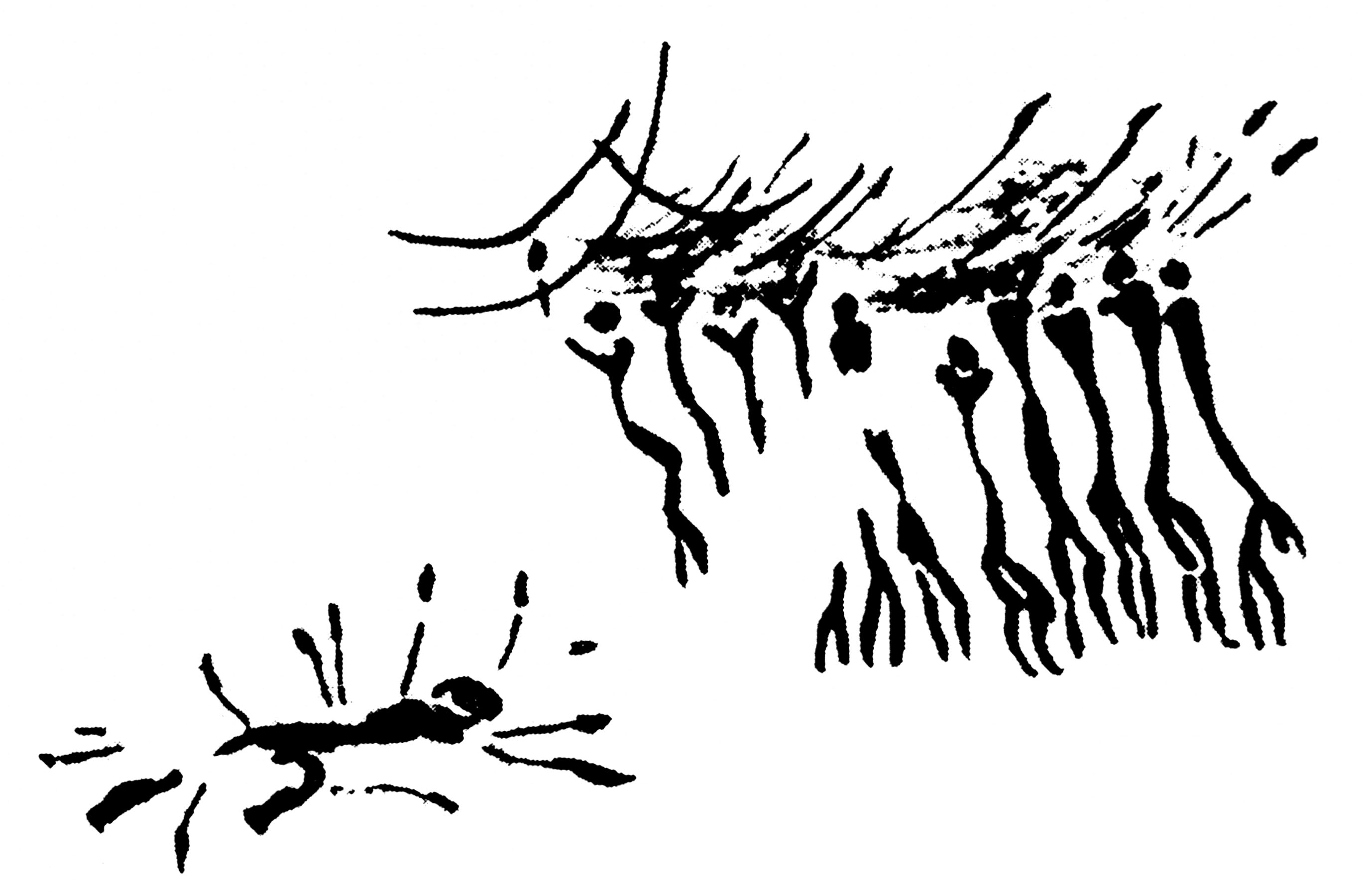
"What you got there, Dad?" Allan asked.

"Just an idea for a sign to go over our gate, including a name for this place," replied Tom

"Well, we sure as heck need a name," said Allan, "calling it 'this place' is getting lame."

Tom handed him the sheet and he looked it over. "Porcupine Refuge Co-operative, eh?" Allan said, "I get the 'Refuge Co-operative' part, but what's the connection with porcupines, and what's the graphic? It almost looks like a cave painting."

"It is a cave painting," said Tom, "and while there are various theories about what it means, the one I like best is that the guy on the ground with all the arrows sticking out of him—kind of like a porcupine—is an alpha male who just wouldn't take the hint when the other people in the band suggested that he move on. You can see that the others are pretty thrilled about doing him in."

"And this is a reminder to any individual who tries to set themselves above the rest of us here at 'Porcupine'?" asked Allan.

"You got it in one!" Tom said with a smile. "What do you think?"

"Looks good to me," said Allan. "I hope we can reach a consensus on it, eh?"

"Yes indeed," said Tom, "I hope so too. If you and I are good, perhaps we should head back and see if there's any supper left."

"I'm good, and hungry," said Allan. "Lead on."

When they got back to the house, supper was just finishing up. Karen sat them down at one of the big tables in the dining room, in front of plates of spaghetti and meat sauce. "I hope you two have got whatever it was out of your systems," she said.

"Yep," said Tom, "we're feeling much better now. Would you mind asking Angie to join us?"

"Yes sir," Karen said with a mock salute and headed for the addition. She was back in a moment with Angie.

"Hi Angie," said Tom, "I probably should have had you facilitating this meeting from the get go. Allan and I are all sorted out now and we'd like you to take over and facilitate the rest of the meeting. I need to finished my thoughts on ecology and then go on to the next section.

"Well, if all you are going to do is stand there and talk, maybe take a few questions, there won't really be much facilitating to do, will there?" said Angie.

"I'll grant you that," said Tom. "Not at the start, anyway. But I'm going to end up talking about participatory, consensus decision making. After that I'll introduce you. And then I have a suggestion that will spark our first bit of group decision making."

"I guess that might work," said Angie with a frown. After a moment's thought, she switched to a smile, and added, "OK, let's do it. What's this first decision about?"

"An idea for a name and logo for this place," said Tom. "You take over, give me a chance to make my suggestion and then I'll get out of your hair."

"Somehow I doubt that," replied Angie, "but sure."

"OK, we'll just finish eating and then I'll continue where I left off before."

A few minutes later Allan and Tom entered the addition. Allan took his seat at the back next to Erika, and watched Tom continue to the front of the room and pick up his marker.

"He get you straightened out?" Erika whispered in Allan's ear.

"Yeah, that's pretty much what happened," replied Allan.

"I hope you'll excuse the interruption," said Tom, "at least it gave you a chance to have supper. Anyway, I think Allan and I have our differences sorted out now. And he helped me get my thoughts in order for the rest of this."

Tom went on, going over all of what he and Allan had discussed before supper and, in Allan's opinion, doing a better job of making his points than he had the first time through. There were a few questions, but Tom fielded them all with no trouble.

"So, those are my thoughts on how we should run this place," said Tom. "I know I was never officially appointed boss around here, just sort of fell into by virtue of having started things, but at this point I am officially stepping down. This leaves us without a leader and better off for it. But a central role in participatory decision making is that of the facilitator. A facilitator is not a leader or boss, but more of a referee. And we are fortunate to have among us someone who is a trained and experienced in that role. I think you all know or at least have met Angie Ferguson. Angie, why don't you come on up here and take over from me."

Angie came to the front. Tom handed her his marker and then took a seat beside Karen.

"Maybe take over isn't exactly the right word, since I'm not going to be running things either," said Angie with a wink directed at Tom. "But I take your meaning. We really need to arrange some introductory training in this style of decision making for all of you, and also get a few more people trained as facilitators so we can share that duty around and avoid me becoming another de facto boss. We obviously can't do that tonight though. What we can do is discuss an issue Tom wants to bring up. Back to you, Tom."

"Thanks Angie," said Tom, standing up, but pointedly not resuming his former position at the front of the room. "I think we've all noticed that it's getting pretty awkward not having a name to call 'this place'. So, I have a suggestion."

He'd rolled up the big printout and brought it with him, and now he unrolled it and held it up in front of his chest. "The Porcupine Refuge Co-operative is my suggestion, and it comes with a graphic that I think we should paint on a sheet of plywood and mount above our front gate."

"Where the heck does 'porcupine' come from, and how does it relate to that graphic," asked Erika, "or to what we are doing here?"

Tom was a little thrown by this, and hesitated long enough for Angie to step in, "Bet you thought this would be easy, didn't you Tom?" she said with a grin. "You've already explained this to Allan, right? Just share with us what you said to him."

"Allan made it pretty easy on me," said Tom, "easier than his better half is doing, anyway. So, the graphic is a cave painting..."


Coming soon, The Porcupine Saga Part 7, When We Met Jack.


Links to the rest of this series of posts:
The Porcupine Saga

Maintaining the lists of links that I've been putting at the end of these posts in getting cumbersome, so I have decided to just include a link to the Porcupine section of the Site Map, which features links to all the episodes I've published thus far.

Wednesday, 5 January 2022

Collapse You Say, Part 10/Time for Change, Part 1: Money

Waves, rocks and ice on the Lake Huron shore

Earlier in this series (Parts 5 and 6) I looked at overpopulation and overconsumption and concluded that while both are serious problems, overpopulation is going to take decades to solve, while overconsumption could be addressed quite quickly. By reducing our level of consumption, we would reduce our impact on the planet and give ourselves time to reduce our population.

In my last post I looked at some of the unintended and negative consequences of the industrialization we've experienced over the last few centuries. I concluded that most of the blame for overconsumption can be laid squarely at the feet of capitalism, with its insatiable hunger to accumulate wealth, its inescapable need for endless growth, and its inability to tackle any problem that can't be solved by making a profit. These days some people are calling capitalism a "death cult", based on those characteristics and the fact that we live on a finite planet. I think they are quite right to do so.

Clearly, the blame for overconsumption should not fall on the supposed innate greed and materialism of individual, ordinary people. The upper classes (mainly capitalists) are superlative consumers and do a great deal of harm themselves. And their marketing efforts have turned the rest of us into pretty good consumers, too. Turn off their incessantly blaring marketing machine and things would be quite different—reducing consumption would look at lot more doable. We'd have a real chance of solving both of our major problems (overpopulation and overconsumption), getting ourselves out of overshoot and avoiding at least part of the die-off that is currently looming ahead of us.

It seems that at this point in this series of posts I am done trying to show that collapse is real and I'm ready to look at what we can do about it. And that is why I am changing the name of this series in the middle of it. It is, indeed "time for change". In truth, I probably should have made the name change starting at Part 7, but it's too late for that now.

Of course, many people in the "collapse sphere" will tell you that what we face is a predicament, not a problem—in the sense that it can't be solved, only adapted to. To those folks I would say, relax—I agree. My idea of a solution to the problems facing us is for us to adapt to them, and that adaptation will probably look a lot like collapse to many of you. We need to have fewer people, all consuming at lower levels that can be sustained by the biosphere, and we must start using up non-renewable resources at a drastically lower rate, until we can manage to replace them with renewables. To quote John Michael Greer, we need to get by with LESS—less energy, less stuff, less stimulation (entertainment). If we choose to do nothing, we'll get there via a brutally hard and deep collapse. But if we deliberately work at adapting instead of trying to save "business as usual", we can get there by a much gentler route, with a lot less grief, and with a better outcome at the end. Still involving major changes to our supposedly "non-negotiable" lifestyles, though.

At the end of my last post (months ago) I promised to tie up a couple of loose ends in my discussion of finance and government, and to talk about how to solve our overconsumption problem by getting rid of capitalism. Over these last few months, I've come up with a wealth of material on these topics and so what was to have been a single post will now be broken up into at least three: I'll be talking about money (finance) today, hierarchies (government) in my next post and what to do about capitalism in the one after that.

Money

Money is a tool and, like all technology, it is not neutral but is designed to be used by certain people for a certain purpose. Money is used by rich people to make more money—to accumulate wealth, and to control poor people. Sure, it can be adapted to other purposes, but I don't believe we can ever stop it from being used for those basic, inherent purposes.

If you study basic economics, you'll be told that money has three primary uses: as a medium of exchange, a unit of account and a store of value. All three of those really just amount to keeping score in the complex game that is our economy. That score keeping is done in ways that facilitate the business of accumulating wealth. This helps those with lots of money get more of it, and works against those with little. We are told that not keeping score would be even worse, but the more I look into it, the less reason I see to believe that.

Capitalism started out with capitalists using their own money to build infrastructure (factories, mines, railways, etc.) to build stuff, which could then be sold for a profit. This soon changed to using borrowed money to do the same. The banks did very well on that, and before long the other capitalists saw that it is possible to use money directly to make more money, dispensing with factories and production of physical goods. This is known as "financialization" and while there are still lots of factories, making lots of stuff (much of it unnecessary), the financial sector is in some ways the business success story of the last century.

Unfortunately, our financial system creates money as debt, which must be paid back with interest. In order to do that, the economy must continually grow. If growth stops or even slows down, it collapses. At the same time, the eventual consequence of growth is also collapse.

The other primary use of money is as a tool for social control. Everything we need has been monetized—the only way to obtain the necessities of life (and much else) is to pay for them with money. Only a very few people live self-sufficiently today, outside of this system. The rest of us need money to live, and a job to obtain that money. In capitalist societies, most of the value created by your work goes to the capitalists, with as little as possible going to you as wages. This makes it challenging to get ahead.

During my lifetime, it stopped being possible to save up enough money to buy large ticket items like an education, a car, a house and so forth. For most people, especially those without rich parents, such things are necessities and can only be had by going into debt to get the required money up front. And it is getting harder and harder to pay back that debt. But that debt must be paid back is a strong value in our culture. To declare bankruptcy and effectively have your debts forgiven means losing essentially everything you have worked for. This leaves us in a position of being under the control of the banks, with very little that we can do about it.

If you look closely, though, you'll see that while not paying debts has nasty consequences for the lower classes, people in the upper classes can often come to some other arrangement if their debts become too onerous. In particular, capitalists whose businesses fail often walk away with little or no consequences since those businesses are set up as corporations with "limited liability".

So, it's pretty clear that in any society that uses money (keeps score) and makes accumulation of wealth a goal, the result will be ever growing inequality between the upper classes and everyone else. In the past, many societies that used money and debt, even without capitalism in the modern sense of the word, found that for the lower classes debt grew over the years until it crippled society. That was because the lower classes played an important part in those societies and when they were crushed under a mountain of debt, the whole society was negatively affected. It was necessary to have a "jubilee" every so often and forgive debts in order to get things working again.

But under modern capitalism, that's never going to happen—the lower classes are, to an ever greater extent, seen as not having an important role to play. Much of traditional work has been replaced by automation. If we are crippled by debt, it doesn't immediately bring our whole society to a halt. Indeed, much of that debt is held by the upper classes, who see it as a benefit. For the rest of us, debt offers a means to allow us to continue consuming, borrowing money just to give it back to the capitalists, with little time for thought about long term consequences.

Most of us are like fish swimming in a sea of money and monetary concerns, unaware that there is any alternative. We are certainly told that there is not. But we need to ask ourselves if money and this whole "keeping score" thing is beneficial or even necessary? Is there any way we could manage to get by without money?

Economists will tell you that money was invented to get away from the inconveniences of barter. But anthropologists who have actually studied pre-monetary societies, would tell you that that is nonsense—barter was used rarely, mainly for trading with strangers. Inside a community, among people who know each other, there are ways of living without money or barter. We'll go into more detail on that in a bit.

Conservative moralists, who have a great deal of influence these days, are concerned about "moral hazard"—telling us that keeping score using money is necessary to maintain fairness, and make sure that people don't take advantage of each other. In fact, very few people do take advantage. And keeping score mostly leads to growing inequality, which is in itself unfair.

And, of course, accountants would have us believe that the whole of modern civilization would grind to a halt if their ledgers didn't balance.

That's all very convenient for those at the top who actually do benefit, but most of these things could be eliminated without hurting the rest of us. And what's really necessary could be rearranged to benefit us and not just the rich.

If we turn to the study of anthropology again, we find that quite frequently during our prehistory we lived in small egalitarian bands who did just fine without money and largely without keeping score. What little score keeping there was, was informal and aimed at censuring people who didn't share well, to prevent accumulation rather than facilitating it.

For such hunter gatherers getting an adequate supply of protein was often challenging and that is one reason why hunting larger game was done enthusiastically, even though it was often not very successful. Hunters were expected to share the meat when they did make a kill, and generally did so, without expecting thanks or any special treatment for making this contribution.

Scientists studying such societies have observed that altruism (sharing) is a strong part of the culture, and have been puzzled about how altruism could be selected for on an evolutionary basis. It would seem that any individual with an inclination to share would inevitably be taken advantage of by less altruistic people, and individuals with innate altruistic impulses would soon be selected out of the gene pool. And indeed they would have been, if selection was acting solely on individuals. But selection also acted on the level of bands, and bands whose members shared well did better and were selected for strongly enough that such behaviour was eventually evolved into human beings. Mutual aid is a powerful tool for achieving success in groups and a major factor in the evolution of many species, certainly including our own.

Even today one can observe that there is a great deal of benefit to acting on a basis of mutual aid, working together altruistically in groups. In societies such as ours where there seems to be an ethos against altruism (a la Ayn Rand), people still do act altruistically, often as if compelled to do so. This tends to reduce the effectiveness of money as a control mechanism, and so it is not popular with those in power, but it still happens. And even in large capitalistic companies, in those cases where people are still working together in groups, you will find a co-operative, egalitarian culture, because it is the best way of getting the work done. Of course, management prefers to isolate workers, so as to better control them. Solidarity is a dangerous thing, from management's viewpoint.

Hunter gatherers had very little in the way of possessions—their nomadic lifestyle didn't allow for much in the way of accumulation. So you might say that money would have been of little use to them anyway.

But many tribal societies practicing herding or even sedentary agriculture, who had more in the way of possessions, and more opportunity to accumulate wealth, often got along without money or score keeping as well. In some such cultures, when you compliment another's possession, the owner is obligated to give you that possession. Strange as it seems to us, this is the basis of exchange in these societies and it works just fine for them. Since everyone is subject to the same rules, being greedy backfires very quickly.

It has become clear to me that the concept of fairness is quite different between monetary and non-monetary cultures. Diametrically opposite, in fact.

In our monetary society, fairness means playing by the rules, rules that are intended to facilitate accumulation. Successful people are expected to accumulate wealth. Indeed that is our definition of success—we are taught to admire such people, and to aspire to be like them.

In pre-monetary societies, fairness meant behaving altruistically—sharing, being generous and serving the other people in your community rather than taking advantage of them. Because the groups were small, it was obvious to everyone when an individual failed to share and do their part, and such individuals faced censure from their fellows.

If they had kept score you would see that, over time, the rest of the community came to be more and more indebted to skilled people. To our modern eyes, it might seem like the less skilled were taking advantage of the more highly skilled, but they didn't see it that way. Indeed it was frowned upon for successful people to put on airs in such cultures, or to use their skills to accumulate wealth. They considered it their responsibility to support their community. It was seen as just what human beings do, to the extent of their abilities. And everyone expected that their needs would be seen to by their community, to the extent that was possible. The result of all this was strongly beneficial to the community as a whole, including those we might see as being taken advantage of.

If that sounds like communism to you —from each according to their ability and to each according to their needs—you're right. That is exactly what it was, and a good thing, too.

Occasionally, in our lengthy pre-historic past, the idea of money (or at least the concept of credit) was adopted by various cultures. It caught on pretty quickly because it could be used for all the "advantages" we've been discussing here. In some cases there were also built in mechanisms for redistributing wealth—things like potlatches, funeral feasts and so forth, so that inequality didn't grow destructively, and runaway growth didn't have its inevitable environmental effects.

In other cases where inequality was allowed to accumulated across generations, the mass of people soon caught on and rebelled, reverting to more equitable ways of organizing things. In still other cases, societal collapse resulted. And finally, in cases where neither of those things happened, you ended up with the societies that eventually developed into to our modern capitalist civilization. Sadly, by the time those who were on the losing end of such arrangements realized what was going on, it was too late—those at the top of the organization were firmly in control, and not interested in changes that would impinge negatively on them. We were stuck in the sort of societies we currently have. Which brings us to the subject of hierarchies, which I will get to in my next post.

What I am intending to suggest here is that there are ways of supplying the needs of a society without causing inequality to grow. And without needing the economy to grow endlessly beyond the capacity of the planet to support. The sort of examples I've mentioned here are only a very few of the ways this might be done and I believe we may yet come up with new ideas that work even better.

In closing, I should probably (for the sake of completeness, but with little hope of achieving it) make a few comments on markets and property.

Markets

At the most basic level, markets exist to place a value on goods and services. But never forget—the value of goods only needs to be determined because we are keeping score, and using money to do it. In any case, the supposed magic of the "free market" is largely theoretical. At best, it can only work when all the players involved have roughly equal power. In capitalism, the capitalists have considerably more power than workers and consumers, and love markets because they are open to manipulation and control. Being able to game the market actually creates many of the problems inherent to capitalism.

Property and Ownership

The concept of private property is central to enabling the accumulation of wealth. The strong take what they wish, have the power to hold onto it, and use it to generate further wealth. Civilization consists largely of having laws to protect the private property of the rich and a police force to enforce them.

In such a system, owners have the right to abuse their property and deplete its resources, with consequences that are currently beginning to come due the world over (climate change, habitat destruction, resource depletion). In a sustainable society, land and resources would be the property of the community as a whole and that ownership would be about stewardship not exploitation.

We should also be clear that there is a distinction here between private and personal property. Personal property consists of items that you use in daily life (like your toothbrush, and your shoes and clothes). A community might elect to extend personal property rights to tools, homes and garden plots. But if you take property rights much further, you end up with individuals having the right to exploit land and resources to their own benefit and the detriment of the community and planet as a whole. Which is exactly what we want to avoid.


During the last few months while I've been dragging my feet about writing for this blog, I've been reading a number of very interesting books, which bear upon what we are discussing. Here is a list of those books, along with a few that I've read previously, but that also have been a help.

Debt, The First 5000 Years, by David Graeber

Hierarchy in the Forest: the evolution of egalitarian behavior, by Christopher Boehm

The Art of Not Being Governed, by James C. Scott

Against the Grain, a deep history of the earliest states, by James C. Scott

Living at the Edges of Capitalism: Adventures in Exile and Mutual Aid, by Andrej Grubacic

The Dawn of Everything, by David Graeber and David Wengrow


Links to the rest of this series of posts: Collapse, you say?

Thursday, 20 May 2021

Collapse You Say, Part 9: Unintended Consequences of Industrialization

Sunset Over Lake Huron

In my last post I looked at some of the factors that made industrialization possible, and with it the huge growth in consumption that now threatens the continued survival of our civilization.

During the industrial age all those factors interacted in complex and unpredictable ways, producing not just the intended results (more wealth and power for the already rich and powerful), but also a variety of unintended, and in many cases unwelcome, consequences. So much so that at this point the switchover to fossil fuels as an energy source, and the industrialization that it enabled, is starting to seem like a mistake for all but the small number who have profited the most from it. Unfortunately, while many people are beginning to have an inkling that something isn't right, very few have any idea what it might be.

Some of these unintended consequences are contributing to collapse in general, others are specifically related to the issue of overconsumption. So as not to lose sight of the big picture, I am going to talk about both.

Resource Depletion, declining surplus energy

When it came to fossil fuels and various other mineral resources, we used the low hanging fruit first. That is, the highest quality and easiest to access resources.

Those days are over and, while there are still large quantities of hydrocarbons in the earth's crust, they are, for the most part, in forms and locations that are much more difficult to access and which provide less surplus energy. Starting in the 1970s our economy has been confronted, for the first time since we started using fossil fuels, with reduced availability of surplus energy. Despite everything governments and central banks have been able to do, real growth has slowed. This has caused problems for our financial system, as we'll see in more detail in a moment.

Fossil fuels were a one-time windfall of abundant surplus energy. That is now gone and there's no going back to the way things were. We used that windfall in such a way as to leave relatively little in the way of a positive legacy. All the available alternative, renewable energy sources have a significantly lower EROEI, providing much less surplus energy. Not enough to sustain economic growth of the sort we have become accustomed to. Probably not even enough to maintain our high tech civilization.

Depleted reserves of many important minerals are also going to make it difficult to maintain that civilization.

Depletion of non-renewable resources is a very serious problem which we hardly take seriously at all. Economists assure us that we can always find substitutes for anything that is becoming depleted, but they are flat out wrong. There are many things for which there just aren't any practical substitutes—fossil fuels, copper, and phosphorous being high on the list.

There are many things we can do to reduce the rate at which such resources are being depleted, but eventually we will still run out. It seems to me that this will necessitate significant changes to our supposedly non-negotiable lifestyles.

Resource depletion is, of course, a result of overconsumption, rather than a cause.

Climate Change, Ocean Acidifcation

When fossil fuels are burned, carbon that was trapped underground million of years ago is released back into the atmosphere as carbon dioxide (CO2). CO2 is a greenhouse gas and increased amounts of it in the atmosphere are leading to a variety of changes in our climate—mainly heating, but also shifting of rainfall patterns and more and heavier storms. CO2 is also strongly absorbed by the oceans, resulting in ocean acidification, with negative effects on many of the oceans' ecosystems.

Methane (CH4, natural gas) is also a significant greenhouse gas. Quite a lot of it leaks into the atmosphere between the well head and where it is finally used. And higher temperatures release methane from where it is currently trapped in permafrost and undersea deposits of methane clathrates.

The effects of climate change, such as rising seas destroying shoreline properties and agriculture suffering from heat and drought are going to be very hard to cope with in the years to come, and will be a major factor in the continuing collapse of our civilization.

Climate change is also a result of overconsumption, rather than a cause. Many of the negatives effects of overconsumption actually show up as climate change.

Pollution, Habitiat Destruction, Ecosphere Damage

Of course greenhouse gases are a form of pollution, but there are many other types of pollution resulting from industrial activities, which have had negative effects on the planets ecosystems and will continue to do so for a long time yet.

The spread of mankind across the globe and more recently the spread of the large scale agriculture and forestry needed by our population, has resulted in the destruction of habitats for many species, and a decrease in biodiversity.

Elsewhere in this series I have said quite a bit about the carrying capacity of the planet and how growth of human population and consumption has resulted in our overshooting that capacity. The important thing to understand is that when we overuse the services provided to us by the biosphere, the biosphere suffers and it's carrying capacity decreases, making the overshoot even worse.

Pollution, habitat destruction and biosphere damage from overuse are all effects of overconsumption.

The "New" World

The so-called "new" world was, of course, not empty. The history of the European colonization is largely a story of the oppression, and in some cases outright genocide, of indigenous people by Europeans. While it is convenient to pretend otherwise, this is still going on and has a destructive effect on societies that continue to let it happen. This too is an effect of overconsumption, albeit somewhat indirectly.

The Financial System

The financial sector of the economy provides services to do with managing money. But what is money, anyway? If you've studied economics, you were told that money is used as a medium of exchange, a unit of account and a store of value. That's more or less true, but the most important thing about money is that it can be used to make more money. That's how businesses operating in the financial sector make their profits. It's also what drives growth, or perhaps "necessitates growth" would be a better way of putting it.

In a rapidly growing economy there is a great demand for money to build new infrastructure. Existing money is insufficient, so that demand can only be provided using credit, and "fractional reserve banking" is the solution. This simply means that banks are allowed to lend out more money than they have on deposit, usually by a factor of ten. Money is created (out of thin air, basically) when a bank makes a loan. So, in one very important sense, money is debt. Today that is the only way that new money enters the economy. In order to make a profit, banks require debts to be paid back with interest, using money to make money. And by the way, when a loan is paid off, the money essentially disappears, back where it came from.

Where does the money to pay the interest come from? Well, you might say, if a business is profitable, it will be earning more than enough money to pay the interest. True, but where does the money it earns come from? From other businesses and people, who have taken out loans which also have to be paid back with interest. And of course, the money for that interest comes from yet more loans.

As long as the economy is growing, this works just fine. But if growth slows a point is reached where profits fall off and businesses struggle to make loan/interest payments. They are understandably hesitant to take out new loans and banks are reluctant to issue them. If this goes on, eventually businesses can't get credit to finance their day to day operations, and with no new money entering the system they can't pay the interest on their loans. Businesses start to default on their loans and if enough loans are in default, banks themselves start failing.

Banks can reduce their interest rates to allow for lower rates of economic growth, offering cheap credit to stimulate growth, but when interest rates have been reduced close to zero, little more can be done. Over the last few decades the robust economic growth we had previously experienced was replaced by market bubbles (fake growth) and the crashes that happen when those bubbles burst.

All this is why financiers, business men, politicians and even many working class people are so concerned about maintaining economic growth. But economic growth means growth in consumption, and has lead to our current overconsumption problems. It seems that in order to address those problems we will have to stop economic growth and actually experience "degrowth", until our consumption reaches a level that the planet can support on a sustainable basis. In order to do this, we need a financial system that doesn't break when growth stops.

It is important to understand that, despite all this talk of money, what really drives the economy is surplus energy. It seems ironic to me that, after forcing growth in the economy for the last few centuries, the financial system is now struggling because of reduced surplus energy, a situation brought about by overconsumption caused by growth. So, clearly, the financial system is one of the causes of overconsumption.

Throughout the history of the blog I have been talking about these three factors: resource depletion (including Peak Oil), environmental degradation (including Climate Change), and a financial system that drives growth, and can't cope with degrowth, as being the main causes of collapse. I could stop here, but it has become clear to me that overconsumption is also contributing to collapse and there are a number of other factors that cause overconsumption. We need to have a closer look those factors if we are going to figure out how to get them under control.

Capitalism and Industrialization

Industrialization was achieved largely using a system called capitalism. It consists of an upper class who own the means of production and a working class who do the work involved in the production.

Based on their ownership of the means of production, the upper class claims the right to the majority of the profit from that production, even though they do very little of the work involved. The working classes are paid either a wage based on the time they spend working or a piece rate based on the quantity of production they do. In either case, the owners try to pay as little as possible in order to maximize their profits, and since the working class has no other way of making a living, they can co-operate or starve.

Capitalism and Industrialism as a cause of over consumption

The main goal of capitalism is to facilitate the accumulation of further wealth by the upper class. Unfortunately, "enough" is not a concept that enters into it, as capitalists are always looking to grow their enterprises and increase their wealth. Indeed, in modern public corporations, stockholders are liable to object if growth is not speedy enough. And, of course, as I said in the last section, the way our financial sector is organized forces capitalists keep to growing their enterprises.

Industrialization has allowed us to produce ever more goods ready to be consumed. As long as there is a demand for those goods, the economy will grow. I suspect that at the start of the industrial age, when most manufactured goods were still made slowly and laboriously by human muscle power, there was a good deal of pent up demand for those goods. As we industrialized, factories were able to make goods more cheaply and in great quantities. It wasn't long before there was a problem of over production, or under consumption, depending on how you look at it.

In addition to that, the nature a factory is to produce large amounts of one particular thing, and once you've invested in a factory, there had better be a market for that thing, whether anyone really needs it or not. This results in the "supply push" model of business, driven by the need to pay off investments in production equipment, and of course, to accumulate more wealth.

Many strategies have been devised to increase consumption, so as to keep up with production, and ensure the flow of wealth into the capitalists pockets. Today these include, but aren't limited to, the following:

  • consumerism, where people are encouraged to see themselves defined in terms of what they buy, and to justify their existence by buying more
  • marketing, or the manufacturing of demand, especially for new and supposedly better goods
  • fads, fashion, collecting
  • planned obsolescence
  • frequent technological upgrades
  • deliberate waste
  • greed seen as a good thing

All these strategies to drive consumption have messed with our heads to the point where most of us consumers have a very strange world view. For example, when discussing how to consume less, many of us are liable to start by asking what we need to buy in order to do that. I mean, how else would you solve a problem than by buying something?

Initially, working class people were underpaid and weren't a major force of consumption. It took a long time and a great many strikes to stop the upper classes from thinking of the working class as anything but workers. Sometime in the middle of the twentieth century, working people, at least in the developed world, finally came to be seen as consumers as well as workers, and in some cases were even paid enough to consume effectively. Of course, this only increased our overconsumption.

But even so, capitalists are still their own best customers, the champions of consumption. Globally speaking, the upper classes, the top 10% by income, do about 60% of the consuming. The bottom 50% of people by income only do a little over 7% of the consuming. So it is clear where any attempts to curb overconsumption must focus. Lest we get too smug, though, it is sobering to remember that the top 10% includes about 800 million people—most of the people in the developing world, including most middle class people and even many working class people.

This is also why it would do no good to get rid of poor people, even those whose population is growing quickly. They consume so little that they simply aren't a factor in our overshoot problem.

In any case, we all must do our part to stop goods piling up at the output of factories, and to keep service providers busy. The way the system is set up, failure to do this leads to the shutdown of factories, layoffs, unemployment and, worst of all, reduced profits for the owners. (Sarcasm, yes, but also factual.)

So, capitalism is the driving force behind overconsumption, and as such is causing the slow collapse we've experienced over the last 50 years or so. But capitalism has other negative effects on society as well.

Negative Effects of Capitalism on Society

Under feudalism there was a web of obligations flowing in both directions. Yes, serfs had to work for their lords. But since there was no other way of getting the work done, the lords had to provide the serfs with a way to feed, clothe and house themselves. This mainly consisted of providing access to a "commons", where serfs could grow crops and graze livestock for their own use, gather firewood and so forth. The level of use of the commons was closely regulated, either by the feudal lord or the community that relied on that commons, so there was no "tragedy of the commons".

Under capitalism there is no such web of obligations. The commons was soon enclosed by capitalists who saw it as an under used resource, and proceeded to over use it (a real tragedy). The only way remaining for working class people to satisfy their needs was to buy them from the capitalists using money they earned working for the capitalists. If the capitalists overproduced and the demand for labour went down, workers got laid off and the owners had no obligation whatever to support them.

Capitalism can't even attempt to solve problems where the solution doesn't involve making a profit. Such issues are ignored or, at best, left for government to solve. Even providing what is needed by the populace is only an indirect result of capitalistic production, and if it becomes unprofitable, capitalists stop doing it.

Capitalists feel entitled to an ever growing slice of the economic pie. As long as the economy was growing fast enough, they could have that and everyone else could see some improvement in conditions as well, since the whole pie was growing. But for the last few decades while economic growth has slowed and capitalists have still insisted on taking a growing slice of it, what remains for the rest of us has continually decreased, and economic inequality has increased significantly.

To be clear, all of us in the developed world are going to be consuming a lot less, either deliberately in an attempt to get overconsumption under control, or unintentionally because we've refused to recognize the reality of collapse and it has continued whether we like it or not.

But with the capitalist fixation on economic growth it is certainly a lot harder to do anything effective about over consumption.

Government

During the industrial era many countries switched from aristocracies to some form of representative democracy. Government of the people, by the people, for the people. But this did not make as big a change as one might think.

Because of the need to fund election campaigns politicians find themselves very much beholden to the rich (mainly capitalists). Not only are capitalists incapable of addressing any problem who's solution would stop them from making a profit, but they make sure that government doesn't try to implement any such solution. These plutarchs, hidden behind representative democracies, are short sighted enough that they are unwilling to do anything to slow growth or reduce consumption. The difficultly we are having in implementing any real solutions to climate change is just the most obvious example of this.

Other countries have ended up under totalitarian dictatorships, which tend to be poor and in need of financial support. So the same thing happens, with those who lend them money actually in charge.


To sum up what I've been saying today about overconsumption—it is not a result of innate greed, not a failing of the human race as a whole, but rather caused by a capitalistic upper class bent on maintaining economic growth and the accumulation of wealth at all costs, with no thought of the negative consequences that await us down the road. They have convinced most of us, and themselves as well, that growth and consumption can go on forever on a finite planet.

There are still a few loose ends from the sections on finance and government, but we'll deal with those next time. That discussion will lead us into the main thrust of my next post—what to do about overconsumption.


Links to the rest of this series of posts: Collapse, you say?

Thursday, 13 May 2021

Collapse you say? Part 8, Factors which made industrialization possible

Half of next winter's firewood,
still to be hauled to the back yard and stacked neatly.

In my last post I discussed a number of issues (needs and wants, human nature and politics) that I felt we needed a grasp of before I could go on with the rest of this series. If you haven't read that post yet, it might be a good idea to read it before going on.

Earlier in this series, I identified ecological overshoot leading to the dieoff of much of the human race as a serious problem looming ahead of us. A problem that we are failing to address. Both overpopulation and overconsumption are major contributors to this situation, but overconsumption is the issue which we have the most chance of addressing in time to make a difference—to get us through the bottleneck we are facing. It will, however, require a fairly major change in attitude for many, if not most, people. I think we need to understand why we are overconsuming before we tackle this problem, and that is going to be the subject of my next few posts.

Our economy has grown significantly over the last few hundred years, since 1700 or so, during what might be called the "industrial age". With it affluence and consumption have increased as well, at least in the developed world, to the point where this is no longer a blessing, but a serious problem. The confluence of a number of factors have made this possible, and I'll be spending today's post discussing those factors. In subsequent posts we'll look at the consequences of industrialization, how this has led to overconsumption, and what we might do about the problem.

Surplus Energy

I must give a nod to my Peak Oil friends and acknowledge that fossil fuels have played a key role in enabling economic growth during the last few hundred years of our history.

For any particular energy source, it takes a certain amount of energy to access that energy. Surplus energy is what's left over to be used, and it's what makes an economy work. The more surplus energy, the greater the potential for economic growth.

In pre-industrial economies, mechanical energy comes primarily from muscles (human or animal) and to a lesser degree from wind and falling water. Heat energy comes mainly from burning biomass (firewood, peat, dung, straw, etc.) and to a lesser degree from the heat of the sun. None of these energy sources provided enough surplus energy to drive strong economic growth.

At the start of the industrial age the demand for firewood was getting ahead of the forests of Europe, and those in need of heat were forced to turn to coal. This was fairly easy to do since there were deposits of coal on or near the surface of the land, and it got the industrial revolution off to a good start.

Coal was followed in the latter half of the late 19th century by oil and in the twentieth century by natural gas. All are still being used in large quantities. The high level of surplus energy from these fossil fuels enabled the building of our industrial civilization.

Technology

Soon enough after the start of the coal age colliers were forced to dig deeper to satisfy demand, and when they went below the level of the local water table, it was necessary to pump the water out of the mines before they could be worked. This unprecedented demand for mechanical energy soon resulted in the development of heat engines that could convert the energy of burning fuel into mechanical energy. Once that energy was available, we found a great many other things to do with it beyond just pumping water out of coal mines. This included railways and various sorts of factories where steam engines and eventually electric motors replaced muscle power.

Before industrialization, most goods had been made in small shops employing only a few people, or in peoples' homes, using almost entirely muscle power. The availability of manufactured goods was limited by this and there was significant pent up demand. So the new factories found strong demand for their products.

The "New" World

In the late Renaissance and early industrial periods Europeans "discovered" several new continents that they had not previously know about. They ruthlessly moved in to exploit the wealth of these "new" areas. This gave industrialism a boost in terms of lands that it could treat as empty and natural resources waiting to be developed.

Social Structure

It seems to me that any egalitarian society, faced with the prospect of industrialization, would probably have decided it wasn't worth the trouble—the great possibilities for amassing wealth just wouldn't have held that large an attraction, given the amount of work involved for the majority of the people to benefit just a few. And indeed such societies were colonized and still haven't been successfully industrialized.

At the other end of the political spectrum, totalitarian societies may well have been too inflexible and at least initially rejected industrialization because of the amount of change it entailed, the unwelcome challenge to the existing order of things. And indeed, during the process of industrialization, inflexible aristocracies were eventually overthrown or reduced to mere figureheads and replaced with ruling classes friendlier to industrialization.

Europe seems to have had just the right combination of an upper class at least some of whom (particularly rich merchants) saw change as an opportunity to amass great wealth and hungry lower classes with no choice but to work for the upper classes. Especially after the enclosure of the commons left them with no way to be self sufficient.

Preindustrial wealth mainly took the form of productive land, and there was only so much land available. Industrialization offered many new sources of wealth—things like mines, factories, railroads, banks, etc.

Capitalism

The new upper classes soon became what we now know as "capitalists". Capitalism is an economic and political system which exploits the labour of the working class and facilitates the accumulation of wealth by rich capitalists. It had existed in a nascent form before but really blossomed during industrialization. Indeed capitalism and industrialization went hand in hand and reinforced each other.

The Financial System

The financial sector of the economy provides services to do with managing money. It had already existed for some time, but what it really needed was a rapidly growing economy to enable it to use money to make more money in a really effective way. The high surplus energy of fossil fuels made such growth possible. As with capitalism, finance and industrialization went hand in hand.

Government

The state, with legal systems and police to enforce the concepts of possession and property and to enforce claims, in the form of debt, on others' productivity, was, as always, primarily the servant of the upper classes. Practically every government in the world was eager to support the capitalists and financiers in their effort to industrialize.


Unintended Consequences

During the industrial age all these factors (and many others) interacted in complex and unpredictable ways, producing not just the intended results (more wealth for the rich and powerful), but also a variety of unintended, and in many cases unwelcome, consequences. So much so that at this point the switchover to fossil fuels as an energy source, and the industrialization that it enabled, is starting to seem like a mistake to all but the small number who have profited most from it. Some of these unintended consequences are contributing to collapse in general, others are specifically related to the issue of overconsumption.

I'll be going into detail on that in my next post.

I expect many will find this a short and unsatisfying post (I certainly do), but the alternative was making this the first section of a very long post, so I decided to stop here and continue next time with what I hope will be the more interesting part and not discouragingly long.


Links to the rest of this series of posts: Collapse, you say?